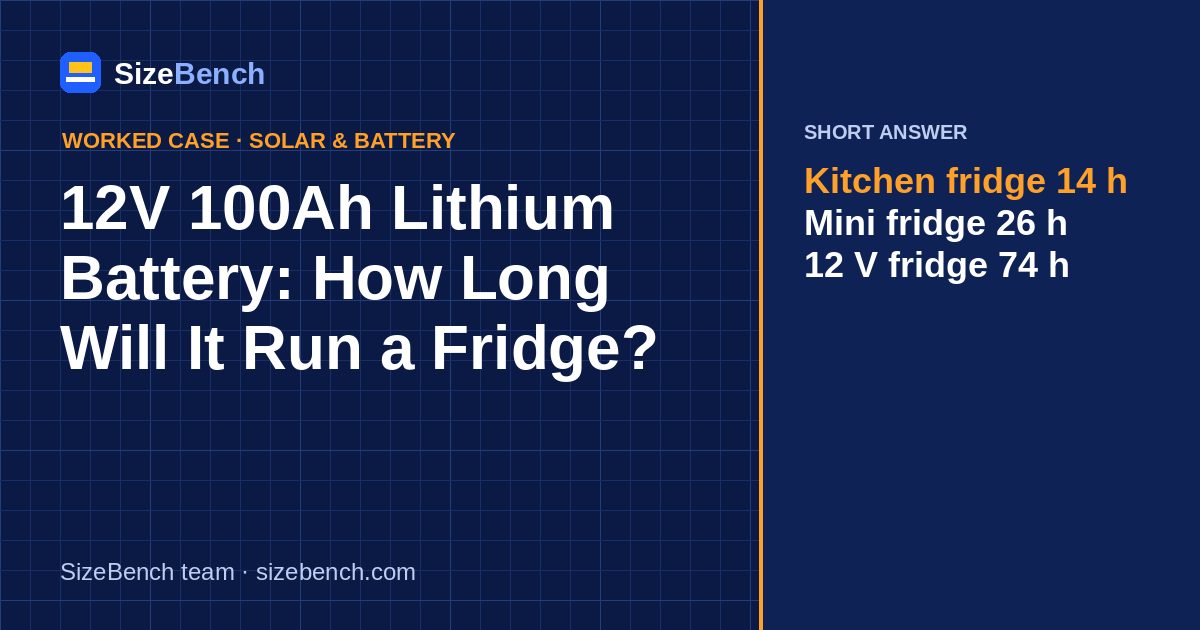
The case: one 12 V, 100 Ah LiFePO4 battery, of which 90% is usable, so 1,080 Wh are available. Three fridges: a full-size kitchen fridge rated 450 kWh/year on its EnergyGuide label running through a 90%-efficient inverter; a compact mini fridge rated 250 kWh/year; and a 12 V compressor fridge wired straight to the battery.
Short answer: about 14 hours for the kitchen fridge, 26 hours for the mini fridge and about 74 hours (three days) for the 12 V fridge in mild weather. A 100 Ah lead-acid battery would run the kitchen fridge for only about 8 hours.

1. Battery energy: amp-hours to watt-hours
Amp-hours mean nothing without voltage. Multiply them:
100 Ah × 12 V = 1,200 Wh
A LiFePO4 battery can be discharged deeply without damage, but most owners and battery management systems stop around 10% to protect the cells. At 90% usable:
1,200 Wh × 0.9 = 1,080 Wh
(The nominal voltage of a LiFePO4 "12 V" battery is closer to 12.8 V. We use 12 V, which slightly underestimates runtime and keeps the answer conservative.)
2. The fridge's real average power
This is where most estimates go wrong. A refrigerator's compressor cycles on and off, so its average draw is a fraction of the running wattage. The best number you have is the yellow EnergyGuide label, which states yearly energy in kWh:
- Kitchen fridge: 450 kWh/yr × 1000 ÷ 8,760 h = 51.4 W average
- Mini fridge: 250 kWh/yr → 28.5 W average
- 12 V compressor fridge: about 350 Wh/day in mild weather → 14.6 W average
The label is measured in a test room at a fixed temperature with the doors closed. A hot garage or frequent door openings push real consumption up, so treat these as best-case averages.
3. The inverter's hidden load
A kitchen fridge needs 120 V AC, so the battery feeds an inverter. Two losses follow. Conversion costs about 10%, and the inverter itself draws power just by being switched on, typically 10 to 30 W for a mid-size pure sine wave unit. We assume 20 W idle for the kitchen setup and 10 W for the smaller mini-fridge inverter.
That idle draw matters enormously on a small battery. Without it, the kitchen fridge would run 18.9 hours. With it:
1,080 Wh ÷ (51.4 W ÷ 0.9 + 20 W) = 14.0 hours
The idle load alone takes more than a quarter of the battery. Check the "no-load current" line on the inverter's spec sheet before buying.
4. Runtime for each fridge
| Fridge | Average load at battery | Runtime | Days |
|---|---|---|---|
| Kitchen fridge + inverter | 77.1 W | 14.0 h | 0.58 |
| Mini fridge + small inverter | 41.7 W | 25.9 h | 1.08 |
| 12 V compressor fridge, mild weather | 14.6 W | 74.1 h | 3.09 |
| 12 V compressor fridge, 90 °F day | 25.0 W | 43.2 h | 1.80 |

5. Lithium vs lead-acid at the same 100 Ah
A 100 Ah lead-acid battery (flooded, AGM or gel) should not be discharged much below 50% if you want it to last, so it delivers about half the energy:
| Battery | Usable energy | Kitchen fridge runtime |
|---|---|---|
| 12 V 100 Ah LiFePO4 (90%) | 1,080 Wh | 14.0 h |
| 12 V 100 Ah lead-acid (50%) | 600 Wh | 7.8 h |
Lead-acid also loses effective capacity at high discharge currents, so the real gap is usually a little wider than the table shows.
6. Adding batteries: runtime by bank size
Runtime grows in a straight line with usable watt-hours, so a second or third battery in parallel multiplies the hours. Same assumptions as above: 90% usable, 90% inverter efficiency and 20 W idle draw for the kitchen fridge (77.1 W at the battery).
| Bank (12 V LiFePO4) | Usable energy | Kitchen fridge | 12 V fridge, 90 °F day |
|---|---|---|---|
| 1 × 100 Ah | 1,080 Wh | 14.0 h | 43.2 h |
| 2 × 100 Ah | 2,160 Wh | 28.0 h | 86.4 h |
| 3 × 100 Ah | 3,240 Wh | 42.0 h | 129.6 h |
| 4 × 100 Ah | 4,320 Wh | 56.0 h | 172.8 h |
Use identical batteries of the same age when paralleling, and connect the inverter leads diagonally across the bank (positive at one end, negative at the other) so each battery shares the load evenly.
7. Sizing the inverter for the compressor start
Energy is only half the problem. A compressor draws a brief starting surge several times its running power. For a kitchen fridge that runs at about 150 W, plan for a start of roughly 900 W:
- Continuous rating: at least 150 W × 1.25, and at least half of the surge → 600 W pure sine wave inverter
- Battery current during the start: 900 W ÷ (12 V × 90%) ≈ 83 A for a second or two
Many 100 Ah LiFePO4 batteries allow 100 A continuous discharge, which covers this, but check the battery's BMS rating and its surge allowance. Use a pure sine wave inverter: modified sine units make compressors run hot and noisy.
8. Reading the labels
- EnergyGuide label (kWh/year): the number for runtime math. Divide by 8,760 for average watts.
- Fridge nameplate (amps at 115 V): the running or maximum current, useful for inverter sizing, not for runtime.
- Battery label: capacity (Ah), nominal voltage, maximum continuous discharge current and charge temperature limits.
- Inverter spec sheet: continuous watts, surge watts, efficiency and no-load current.
9. Installation checklist
- [ ] Fuse or breaker on the battery positive lead, rated for the inverter's DC current
- [ ] Cable sized for the surge current with short runs between battery and inverter
- [ ] Inverter switched off when not in use, or a model with low idle draw
- [ ] Battery kept above freezing when charging; most LiFePO4 cells must not be charged below 32 °F without a heater
- [ ] Fridge in the coolest available spot with ventilation around the coils
10. Recharging
With a 200 W solar panel at 5 sun hours and 75% overall efficiency, you harvest about 750 Wh a day, which covers a 12 V compressor fridge with room to spare, and covers the kitchen fridge's 1,850 Wh daily need only on a good day.
11. Signs of a problem
- The inverter shuts down every time the compressor starts: surge too high for the inverter, or the cable between battery and inverter is too thin and the voltage sags.
- The battery disconnects long before the predicted runtime: the BMS is tripping on surge current or low temperature, or the fridge uses more than its label. Measure for 24 hours with a plug-in energy meter.
- Warm cable lugs or a hot fuse holder: a loose or corroded connection. Fix it before it melts.
- The fridge runs almost constantly: dirty condenser coils, a bad door seal or a hot location. Each one shortens runtime directly.
12. Common mistakes
- Dividing by nameplate watts. Using 1.5 A × 115 V = 172 W as if it ran nonstop predicts only 5.6 hours, far too pessimistic.
- Ignoring inverter idle draw. It can cost a quarter of the battery or more.
- Running the inverter for one small load. If the fridge is the only AC load, a 12 V fridge is the efficient answer.
FAQ
Can a 12V 100Ah lithium battery run a full-size fridge overnight? Yes. About 14 hours with our assumptions, so a 12-hour night uses roughly 86% of the battery.
How many 100 Ah batteries for 48 hours on the kitchen fridge? 3,700 Wh ÷ 1,080 Wh → 4 batteries.
What about a fridge rated 600 kWh/year? Average load becomes 68.5 W; runtime about 11.2 hours.
Does a 24 V battery help? For the same watt-hours, runtime is the same. Higher voltage halves the current and allows thinner cables.
How long does the solar panel take to refill an empty battery? With nothing running, the 1,080 usable Wh need about 1.4 sunny days from the 200 W panel above. With the kitchen fridge also running, the panel cannot keep up: it falls 1,100 Wh short every day.
Does using 12.8 V instead of 12 V change the answer? Slightly. The usable energy rises to 1,152 Wh and the kitchen fridge runs about 14.9 hours instead of 14.0.
Case summary
| Item | Result |
|---|---|
| Battery | 12 V 100 Ah LiFePO4, 1,080 Wh usable |
| Kitchen fridge (450 kWh/yr) + inverter | 14.0 h |
| Mini fridge (250 kWh/yr) + inverter | 25.9 h |
| 12 V compressor fridge | 43–74 h |
| Same fridge on 100 Ah lead-acid | 7.8 h |
| Inverter for the kitchen fridge | 600 W pure sine |
Your fridge has a different label? Enter its average watts in the battery runtime calculator and get the hours for your exact battery.
Try it with your own numbersBattery Runtime Calculator→Sources and references
- U.S. Department of Energy – Estimating appliance and home electronic energy use converting EnergyGuide kWh/year into average watts
- ENERGY STAR – Refrigerators typical yearly energy use of full-size and compact refrigerators
- Ready.gov – Power outages keeping refrigerated food safe during an outage
- SizeBench battery runtime calculator the same runtime formula with your own battery and load
- SizeBench inverter size calculator continuous and surge rating for the fridge inverter
Standards and data behind our calculators
How we made this guide
Every number in this guide is calculated by the same code as our calculators, from the standards listed above, and the page is tested before publication. The SizeBench team researched, wrote and reviewed it; we use automation and AI tools to help draft, never to produce the figures. Our methodology →
Revision history
- · Published