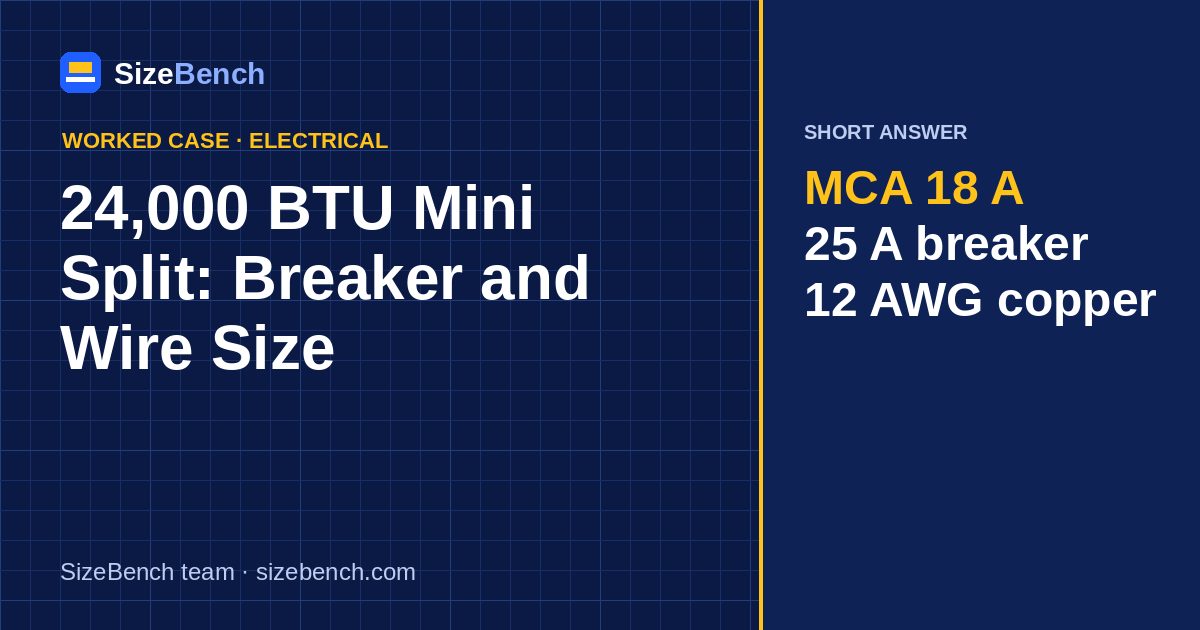
The case: a single-zone ductless heat pump, 24,000 BTU/h (2 tons), rated 208/230 V single-phase. The outdoor unit's nameplate reads MCA 18 A and MOCP 25 A (our example; yours may differ). The circuit runs 40 ft from the panel to a disconnect beside the outdoor unit.
Short answer: a 25 A two-pole breaker (anything from 20 A up to the 25 A MOCP is allowed), 12 AWG copper (12/2 NM-B with ground indoors, THWN-2 in conduit or UF-B outdoors) and a disconnect within sight of the outdoor unit. At 40 ft the drop is 0.93% even at the compressor's maximum rated current.

1. Do not size from BTU; read MCA and MOCP
Air conditioners and heat pumps are the one place where you should not calculate amps from power. The NEC's Article 440 lets the manufacturer do it for you, and two numbers on the outdoor unit's label are all you need:
- MCA, minimum circuit ampacity (18 A here). The wire must be rated at least this much. The manufacturer has already added the 125% factor for the compressor and included the fans and the indoor unit.
- MOCP, maximum overcurrent protection (25 A here). The breaker may not be larger than this. Some labels write "Max fuse/breaker" or "MFS".
Any standard breaker from the MCA up to the MOCP is acceptable; 20 A and 25 A both fit our label. Many installers pick the MOCP value to avoid nuisance trips at start-up, although inverter compressors start softly.
2. Why 12 AWG on a 25 A breaker is legal here
Normally, 12 AWG copper may not be protected above 20 A. Air-conditioning equipment is an exception: the NEC sends you to Article 440, where the nameplate MOCP governs. With MCA 18 A:
| Conductor | Ampacity | MCA 18 A met? |
|---|---|---|
| 14 AWG copper NM-B (60 °C) | 15 A | No |
| 12 AWG copper NM-B (60 °C) | 20 A | Yes |
| 12 AWG copper THWN-2 (75 °C) | 25 A (table value) | Yes |
| 10 AWG copper NM-B (60 °C) | 30 A | Yes, with margin |
So 12 AWG on a 25 A breaker is correct for this unit, and inspectors see it daily. What is not allowed is copying that combination to a general-purpose circuit.
3. What the unit really draws
At an assumed efficiency of EER 11 at full cooling output, the system draws about:
24,000 BTU/h ÷ 11 = 2,182 W → 9.1 A at 240 V
The compressor's maximum rated current can be estimated from the MCA: 18 A ÷ 1.25 ≈ 14.4 A. An inverter unit runs well below that most of the time and approaches it only in extreme heat or deep cold, when it boosts its compressor speed.
4. Voltage drop and distance
Inverter electronics tolerate a range of supply voltage, but a long run on 12 AWG still eats into it at the top of the range:
| One-way length | Calculator pick at MCA, 3% | 12 AWG at 14.4 A | 10 AWG at 14.4 A |
|---|---|---|---|
| 25 ft | 12 AWG | 0.58% | 0.36% |
| 50 ft | 12 AWG | 1.16% | 0.73% |
| 75 ft | 12 AWG | 1.74% | 1.09% |
| 100 ft | 12 AWG | 2.32% | 1.45% |
| 125 ft | 10 AWG | 2.90% | 1.81% |
| 150 ft | 10 AWG | 3.47% | 2.18% |
Up to about 100 ft, 12 AWG is fine. Beyond that, 10 AWG keeps the unit happy at full output, and it is the size to pull if you think you might swap to a 30,000 or 36,000 BTU unit later.

5. How mini split sizes compare
Running current at full cooling output, at the same assumed EER 11 and 240 V. Real labels differ; use this only to see how current scales:
| Size | Input power | Running current |
|---|---|---|
| 9,000 BTU/h | 818 W | 3.4 A |
| 12,000 BTU/h | 1,091 W | 4.5 A |
| 18,000 BTU/h | 1,636 W | 6.8 A |
| 24,000 BTU/h | 2,182 W | 9.1 A |
| 36,000 BTU/h | 3,273 W | 13.6 A |
Is 24,000 BTU the right size? Our AC calculator suggests about 24,000 BTU/h for a sunny 1,200 sq ft space with average insulation, so 24,000 fits a large attic suite or an open living area, not a single bedroom.
6. Disconnect and indoor unit wiring
- Disconnect within sight of the outdoor unit. A non-fused pull-out disconnect is common. If you choose a fused disconnect, size the fuses within the MCA–MOCP range.
- No receptacle on the same circuit. The NEC wants a service receptacle within reach of the outdoor unit, but on a separate general-purpose circuit.
- Interconnect to the indoor head. Most single-zone systems power the indoor unit from the outdoor unit through a four-conductor cable (often 14/4 stranded), per the manual. Follow its wire size and terminal numbering exactly; swapped communication wires are the most common start-up error.
- Outdoor run: liquid-tight flexible conduit from the disconnect to the unit, with conductors rated for wet locations.
7. Reading the outdoor unit's nameplate
The label is usually on the side panel near the service valves. Besides MCA and MOCP, look for:
- Rated voltage, such as "208/230 V, 1 ph, 60 Hz", and sometimes an allowed operating range in volts. If your measured voltage under load falls near the bottom of that range, voltage drop deserves more attention than the 3% rule of thumb.
- RLA (rated load amps) and LRA (locked rotor amps) for the compressor. On inverter units the LRA is often low or not listed, because the drive never starts the compressor across the line.
- Fan motor amps for the outdoor fan, already included in the MCA.
- Refrigerant type and factory charge, which matter to the HVAC installer, not to the wire size.
If the label's MCA is above 20 A, 12 AWG NM-B is no longer enough and the circuit moves to 10 AWG.
8. Single-zone versus multi-zone
A multi-zone system with one outdoor unit and several indoor heads is wired the same way from the panel: one circuit to the outdoor unit, sized from its label. The difference is the interconnect: each head gets its own four-conductor cable from the outdoor unit. A larger multi-zone outdoor unit usually carries a higher MCA, which can push the circuit to 10 AWG copper and a 30 A or larger breaker, always within its MOCP. Several separate single-zone systems need one circuit each, so count your free panel spaces before you choose.
On 208 V service, common in apartment and condo buildings, the same unit draws a little more current for the same output. The label's MCA covers both voltages, so the wire choice does not change.
9. Energy use
At 9.1 A and 240 V, the unit draws 2.18 kW at full output. Assume 8 hours a day at full output on a hot day: 17.5 kWh. Inverter units spend most hours at part load, so a typical day is lower.
10. Installation checklist
- [ ] Breaker between MCA and MOCP: here 20 A to 25 A, two-pole
- [ ] 12 AWG copper (or 10 AWG beyond about 100 ft)
- [ ] Disconnect within sight of the outdoor unit
- [ ] Wet-location wiring method from the disconnect to the unit
- [ ] Interconnect cable per manual, terminals matched 1-2-3
- [ ] Service receptacle nearby on its own circuit
11. Signs of a problem
- Error codes for low or high voltage on start-up in hot weather.
- The breaker trips at defrost or on the first cold morning: check the breaker against the MOCP and all lugs for torque.
- The indoor head shows a communication error: usually the interconnect wiring.
12. Common mistakes
- Sizing the breaker from BTU. Use the label.
- Exceeding MOCP "to stop trips."
- Putting the disconnect out of sight of the unit.
- Using NM-B outdoors. It is not rated for wet locations.
Case summary
| Item | Result |
|---|---|
| Unit | 24,000 BTU/h, 208/230 V |
| Label | MCA 18 A, MOCP 25 A |
| Breaker | 25 A two-pole |
| Wire | 12 AWG copper |
| Drop at 40 ft | 1.16% at MCA |
FAQ
What size breaker for a 24,000 BTU mini split? Whatever the label allows between MCA and MOCP. For MCA 18 A and MOCP 25 A, a 20 A or 25 A two-pole breaker.
What wire size for a 24,000 BTU mini split? 12 AWG copper for an MCA up to 20 A in NM-B; 10 AWG if the MCA is higher or the run is long.
Can I put a 24,000 BTU mini split on 120 V? Only if that model is built for 120 V; most 2-ton units are 208/230 V.
Does the mini split need a neutral? Most 208/230 V outdoor units do not. Use 12/2 with ground.
Can I reuse an old 240 V circuit from a window or through-wall AC? Often, yes, if the existing wire meets the new MCA and the existing breaker is within the new MOCP. A 20 A circuit on 12 AWG copper works for MCA 18 A; you still need a disconnect at the outdoor unit.
Different unit or longer run? Put the label's MCA and your length into the wire size calculator.
Try it with your own numbersWire Size Calculator→Sources and references
- NFPA 70, National Electrical Code (NEC) Article 440 rules for air-conditioning and refrigeration equipment (minimum circuit ampacity, maximum overcurrent protection, disconnect within sight), NM-B ampacity
- U.S. Department of Energy – Ductless mini-split heat pumps how ductless systems are configured (outdoor unit, indoor heads, interconnect) and where they fit
- ENERGY STAR – Air-source heat pumps efficiency ratings used to estimate running current
- SizeBench wire size calculator the ampacity and voltage-drop math used in this guide
- SizeBench AC BTU calculator the room-load estimate used to sanity-check the 24,000 BTU size
Standards and data behind our calculators
How we made this guide
Every number in this guide is calculated by the same code as our calculators, from the standards listed above, and the page is tested before publication. The SizeBench team researched, wrote and reviewed it; we use automation and AI tools to help draft, never to produce the figures. Our methodology →
Revision history
- · Published