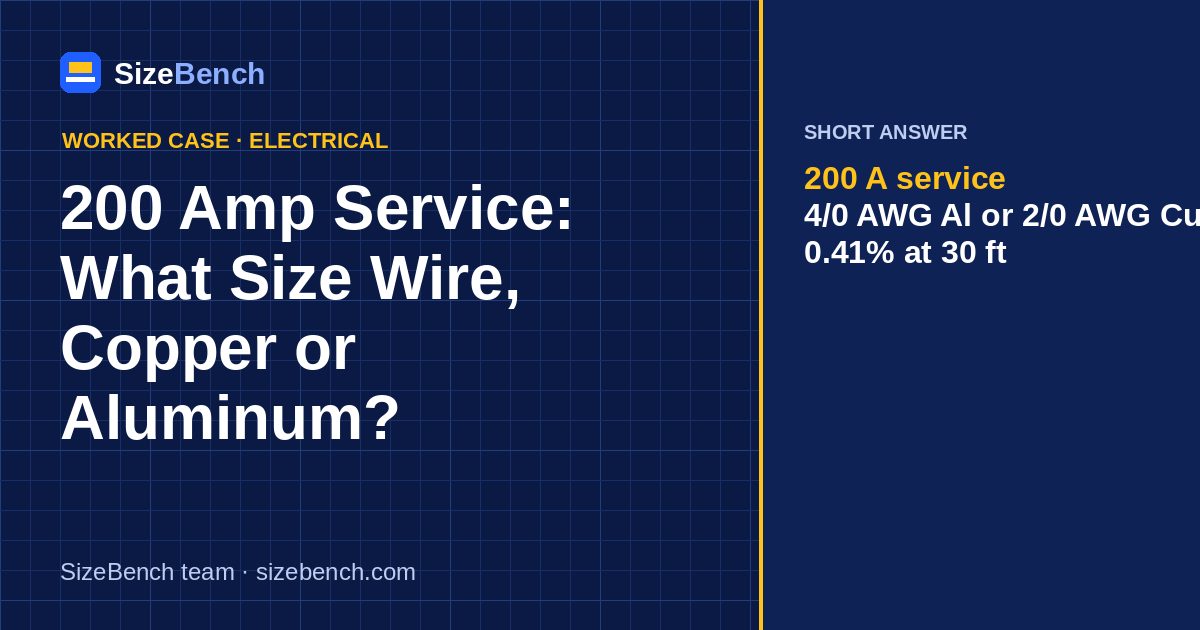
The case: a single-family house upgraded to a 200 A, 120/240 V single-phase service. The service entrance conductors run about 30 ft from the meter base, down the outside wall and across the basement, to a 200 A main breaker panel.
Short answer: 4/0 AWG aluminum or 2/0 AWG copper for the two hots, thanks to the NEC's dwelling rule that sizes the main service conductors at 83% of the rating (166 A). In practice that is the familiar 4/0-4/0-4/0-2/0 aluminum SER cable. Without that rule, a 200 A feeder would need 250 kcmil aluminum or 3/0 AWG copper.

1. The 83% rule for houses
A house rarely draws its full service rating for long, because its loads are diverse: the range, the dryer, the heat pump and the water heater do not all peak at once. The NEC recognizes this for dwelling units fed at 120/240 V: the service conductors, or the main feeder that carries the whole dwelling load, may be sized at 83% of the service rating.
200 A × 0.83 = 166 A
Then you pick the smallest conductor rated at least 166 A at 75 °C:
| Conductor | Ampacity at 75 °C | Meets 166 A (83% rule) | Meets 200 A (full) |
|---|---|---|---|
| 2/0 copper | 175 A | Yes | No |
| 3/0 copper | 200 A | Yes | Yes |
| 3/0 aluminum | 155 A | No | No |
| 4/0 aluminum | 180 A | Yes | No |
| 250 kcmil aluminum | 205 A | Yes | Yes |
2. When the 83% rule does not apply
The reduction is only for the conductors that carry the entire load of a dwelling unit. It does not apply to:
- A feeder to a subpanel that serves only part of the house, a garage or a shop.
- Commercial or most multi-family common-area services.
- A 200 A feeder to a detached building that is not itself a dwelling.
In those cases the conductors must be rated for the full 200 A: 3/0 AWG copper or 250 kcmil aluminum at 75 °C.
3. Copper or aluminum?
For service conductors, aluminum is the norm in American homes, and for good reasons:
- Weight and handling. 4/0 aluminum SER is far lighter and easier to bend than 2/0 copper of the same capacity.
- Equipment is designed for it. Meter bases and main breakers are typically marked AL/CU, and their lugs accept 4/0 aluminum.
- Today's alloys. Modern service conductors use the AA-8000 series aluminum alloys, which behave very differently from the small-gauge aluminum branch wiring that gave aluminum its bad reputation decades ago.
Copper wins when space is tight, when a long conduit run makes the larger aluminum awkward, or when local practice prefers it. Either way, the terminations are what matter: tighten every lug with a torque tool to the value on the label, and use antioxidant compound on aluminum where the lug manufacturer calls for it.
4. Voltage drop: short runs versus pole meters
For a meter on the house wall, voltage drop is negligible. On rural properties where the utility sets the meter on a pole and the owner runs a feeder to the house, distance matters. The table sizes for the 166 A design current at 3%, and adds the drop of 4/0 aluminum at a heavy but realistic 100 A (our assumption for a winter evening with the heat pump, range and dryer running):
| One-way length | Copper at 166 A, 3% | Drop | Aluminum at 166 A, 3% | Drop | 4/0 Al at 100 A |
|---|---|---|---|---|---|
| 30 ft | 2/0 AWG | 0.40% | 4/0 AWG | 0.41% | 0.25% |
| 50 ft | 2/0 AWG | 0.67% | 4/0 AWG | 0.69% | 0.42% |
| 100 ft | 2/0 AWG | 1.34% | 4/0 AWG | 1.38% | 0.83% |
| 150 ft | 2/0 AWG | 2.01% | 4/0 AWG | 2.08% | 1.25% |
| 200 ft | 2/0 AWG | 2.68% | 4/0 AWG | 2.77% | 1.67% |
| 250 ft | 3/0 AWG | 2.65% | 250 kcmil | 2.93% | 2.08% |
So even the farmhouse with a pole meter 150 ft away gets by with 4/0 AWG aluminum (2.08% at 166 A). Past about 200 ft, the next aluminum size up is the safer choice.

5. Why the house needed 200 A
The old 100 A service was full before the new equipment arrived. Here are the large 240 V loads after the upgrade, with our example values:
| Load | Current at 240 V |
|---|---|
| Heat pump (MCA from label, example) | 30.0 A |
| EV charger, 48 A continuous | 48.0 A |
| Range, NEC demand 8 kW | 33.3 A |
| Dryer, 5.6 kW | 23.3 A |
| Water heater, 4.5 kW | 18.8 A |
| Sum of large loads | 153.4 A |
That simple sum is not the NEC load calculation, which adds lighting and receptacle loads per square foot and then applies demand factors, but it shows why 100 A no longer worked and why 200 A leaves room. If the sum of your big loads approaches the service rating, ask for the full calculation or consider a load-management device for the EV charger.
6. Overhead or underground service
- Overhead: the utility's drop lands on a weatherhead above the roof line or on the wall; your service entrance cable or conduit runs from the weatherhead to the meter base. Clearances over roofs, driveways and windows are set by the NEC and the utility.
- Underground: the utility lateral comes up in conduit to the meter base. Many utilities own and size that lateral; others ask the owner to install the conduit to their specification.
- Either way, the conductors from the meter to your main breaker follow the sizes in this guide.
7. Grounding electrode conductor and bonding
The grounding electrode conductor connects the service neutral to the ground rods, the water pipe or the concrete-encased electrode. For 2/0 copper or 4/0 aluminum service conductors, the NEC table calls for 4 AWG copper. Where it runs only to ground rods, it does not need to be larger than 6 AWG copper. Bond the metal water piping and, where present, the gas piping as the inspector requires.
8. What the utility owns and what you own
- Utility side: the service drop or lateral up to the meter, sized by the utility, often aluminum triplex or quadruplex. You do not choose this wire.
- Your side: from the meter base to the main breaker (service entrance conductors), and from a meter-main to the house panel (feeder) on pole-meter setups.
- Meter base rating: must be 200 A or more; many utilities have their own approved list. Call before buying.
9. Reading the panel and meter base labels
- Bus and main breaker rating: 200 A.
- Lug range: for example "#4 – 250 kcmil AL/CU" on the main breaker.
- Short-circuit rating in kA: it must meet the utility's available fault current.
- Service-entrance rated marking if the panel is the first disconnect.
10. Checklist for a 200 A upgrade
- [ ] Permit and utility coordination for disconnect and reconnection
- [ ] 4/0 AWG Al or 2/0 AWG Cu service conductors (83% rule, dwelling)
- [ ] 4 AWG copper grounding electrode conductor; electrodes per local code
- [ ] Lugs torqued to label values, antioxidant on aluminum where specified
- [ ] Neutral and ground bonded only at the service disconnect
- [ ] Load calculation filed if the jurisdiction asks for it
11. Signs of service trouble
- Lights flicker across the whole house when a large load starts.
- Warm or discolored main lugs, or a smell near the meter base.
- Measured voltage at the panel drops more than a few volts under load.
12. Common mistakes
- Applying the 83% rule to a subpanel feeder.
- 3/0 aluminum for 200 A. It is rated 155 A, below even the 83% value.
- Undertorqued aluminum lugs.
- Reusing 100 A grounding conductors after an upgrade.
Case summary
| Item | Result |
|---|---|
| Service | 200 A, 120/240 V, single family |
| Design current (83%) | 166 A |
| Conductors | 4/0 AWG Al or 2/0 AWG Cu |
| Without the 83% rule | 250 kcmil Al or 3/0 AWG Cu |
| Grounding electrode conductor | 4 AWG copper |
| Drop at 30 ft | 0.41% |
FAQ
What size aluminum wire for 200 amp service? 4/0 aluminum for a house under the 83% rule (180 A). 250 kcmil aluminum if the full 200 A applies.
What size copper wire for 200 amp service? 2/0 copper under the 83% rule (175 A), 3/0 copper otherwise (200 A).
Is 4/0 aluminum good for a 200 amp subpanel? Not for a subpanel that only serves part of the load: use 250 kcmil aluminum or 3/0 copper.
How far can a 200 amp service run on 4/0 aluminum? About 200 ft at 166 A within 3% (2.77%).
Why does SER cable say 4/0-4/0-4/0-2/0? Two 4/0 aluminum hots, a 4/0 aluminum neutral and a 2/0 aluminum ground. The two hots carry the 166 A design load; 2/0 aluminum alone is rated only 135 A, which is why it serves as the ground and never as a hot.
Planning a service upgrade or a long pole-meter feeder? Check the sizes in the wire size calculator and coordinate with your utility before ordering parts.
Try it with your own numbersWire Size Calculator→Sources and references
- NFPA 70, National Electrical Code (NEC) 83% sizing rule for dwelling services and main feeders, conductor ampacity tables, grounding electrode conductor sizing, aluminum terminations
- OSHA – Electrical safety hazards of working on energized service equipment and the role of grounding
- Electrical Safety Foundation International (ESFI) homeowner guidance on service upgrades, permits and licensed electricians
- SizeBench wire size calculator the ampacity and voltage-drop math used for every size in this guide
Standards and data behind our calculators
How we made this guide
Every number in this guide is calculated by the same code as our calculators, from the standards listed above, and the page is tested before publication. The SizeBench team researched, wrote and reviewed it; we use automation and AI tools to help draft, never to produce the figures. Our methodology →
Revision history
- · Published