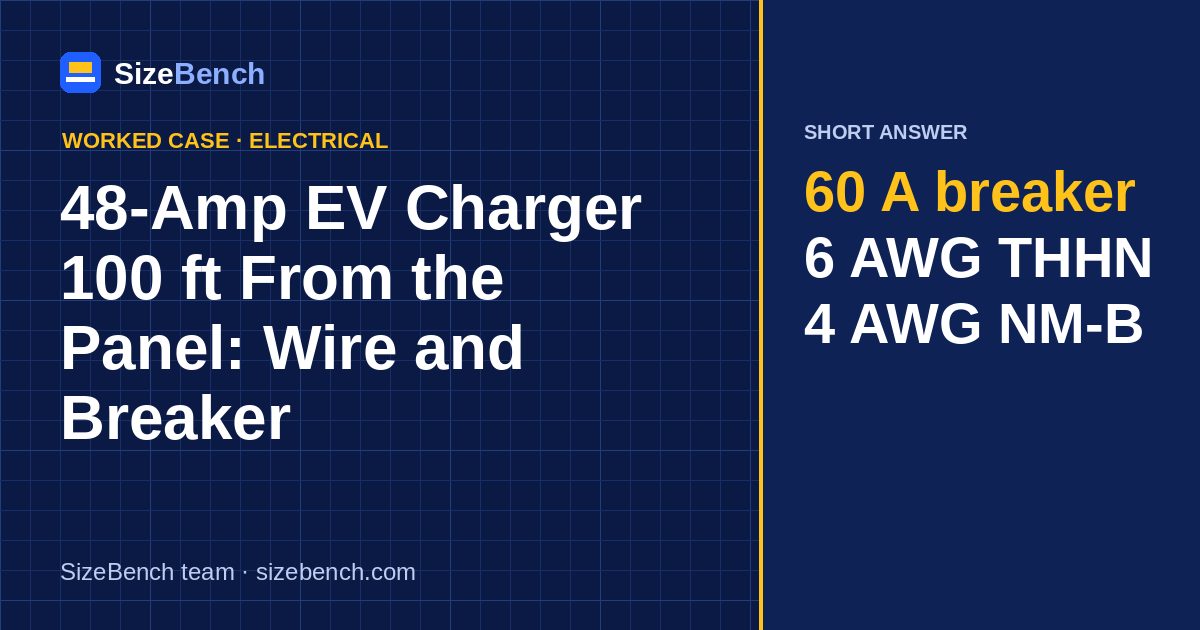
The case: a hardwired Level 2 charger set to 48 A, 240 V single-phase, copper conductors, 100 ft one-way from the panel.
Short answer: a 60 A two-pole breaker and 6 AWG copper in conduit (THHN/THWN-2). If you run NM-B (Romex) cable instead, you need 4 AWG. Voltage drop with 6 AWG is 1.96%.

1. EV charging is a continuous load
The NEC treats EV charging as a continuous load (NEC 625.41): the circuit must be sized at 125% of the charger current.
48 A × 1.25 = 60 A, so the breaker is a 60 A two-pole breaker. This is also why a "48 A charger" always appears next to "60 A circuit" in installation manuals.
2. Wire size by ampacity
The conductor must carry at least 60 A. From NEC Table 310.16 (copper):
| Size | 60 °C column (NM-B) | 75 °C column (THHN in conduit) |
|---|---|---|
| 6 AWG | 55 A | 65 A |
| 4 AWG | 70 A | 85 A |
Which column you may use depends on the wiring method:
- Individual THHN/THWN-2 wires in conduit, landed on 75 °C rated terminals: 6 AWG (65 A) is enough.
- NM-B (Romex) cable must be sized from the 60 °C column (NEC 334.80). 6 AWG NM-B is only good for 55 A, so it cannot go on a 60 A breaker. You need 4 AWG NM-B.
This is the single most common reason EV charger installs fail inspection.
3. Voltage drop over 100 feet
Long runs lose voltage. The NEC recommends keeping branch-circuit drop around 3% (informational note to 210.19). For a 240 V circuit:
VD = 2 × L × I × R ÷ 1000, with R in ohms per 1000 ft.
| Run length | Size that meets ampacity and 3% | Voltage drop |
|---|---|---|
| 100 ft | 6 AWG | 1.96% |
| 150 ft | 6 AWG | 2.95% |
| 200 ft | 4 AWG | 2.46% |
At 100 ft, 6 AWG stays well under 3%. Past roughly 150 to 200 ft, voltage drop starts to drive the size up instead of ampacity.
Notice how close the 150 ft line sits to the limit: 6 AWG still passes, at 2.95%. Measure the real route through attics and down walls, not the distance on the floor plan.

4. The aluminum option for long runs
For runs well beyond 100 ft, aluminum conductors are worth pricing. Using the same 60 A circuit and the same 3% target:
| Run length | Copper (THHN/THWN-2) | Aluminum (XHHW-2) | Aluminum drop |
|---|---|---|---|
| 100 ft | 6 AWG | 4 AWG | 2.03% |
| 150 ft | 6 AWG | 3 AWG | 2.42% |
| 200 ft | 4 AWG | 2 AWG | 2.55% |
At 100 ft, 4 AWG aluminum is rated 65 A in the 75 °C column, enough for the 60 A breaker, and its drop of 2.03% is comparable to copper. Two practical limits decide whether it makes sense:
- Terminals. Many wall chargers accept copper only. Check the installation manual before you buy wire. If the charger is copper-only, a common approach is aluminum for the long run to a small junction box or disconnect near the charger, spliced with AL/CU-rated connectors to a short copper tail.
- Workmanship. Every lug must be AL/CU rated, prepared as the lug maker specifies and torqued to the value on the label.
On a 100 ft run, the savings rarely justify the extra splice. At 200 ft and beyond, they often do.
5. Grounding and GFCI
- Run an equipment grounding conductor: 10 AWG copper is the minimum for a 60 A circuit (NEC Table 250.122).
- Hardwired chargers usually have built-in ground-fault protection. If you install a NEMA 14-50 receptacle instead, NEC 2020 and later require GFCI protection for it in a garage, which means a 50 A GFCI breaker and a charger limited to 40 A.
6. Conduit or NM-B: choosing the wiring method
The calculation gives you two valid answers, 6 AWG THHN in conduit or 4 AWG NM-B. The route decides which one is practical.
- Finished walls and attics, all indoors and dry: NM-B is the easy choice. The trade-off is the larger 4 AWG size, which is stiff, and you should confirm the charger's terminals accept it.
- Exposed garage walls: NM-B exposed below about head height may need physical protection depending on local rules. Many electricians simply run EMT on the surface: it is protected, it looks tidy, and it lets you use the smaller 6 AWG conductors at the 75 °C rating.
- Outdoors, underground, or to a detached garage: the inside of any outdoor or buried conduit is a wet location, and NM-B is not permitted there. Use THWN-2 or XHHW-2 individual conductors in PVC or rigid conduit, at the burial depth the NEC requires for the conduit type. A detached garage also needs its own disconnecting means, so plan for it.
7. 32 A vs 40 A vs 48 A: is the bigger circuit worth it?
A 48 A charger costs more to wire than a 40 A one, so it is fair to ask what the extra current buys. The table below uses two stated assumptions: 90% charging efficiency (losses in the onboard charger and battery) and a vehicle that travels 3.5 miles per kWh, typical of a midsize electric sedan or small crossover. Your vehicle's rating will differ; scale accordingly.
| Charger setting | Breaker | Copper wire at 100 ft (THHN) | Power | Range added per hour | Time to add 45 kWh |
|---|---|---|---|---|---|
| 32 A | 40 A | 8 AWG | 7.68 kW | about 24 mi | 6.5 h |
| 40 A | 50 A | 8 AWG | 9.60 kW | about 30 mi | 5.2 h |
| 48 A | 60 A | 6 AWG | 11.52 kW | about 36 mi | 4.3 h |
For a 60-mile daily commute, the 48 A setting replaces the day's driving in about 99 minutes and the 40 A setting in about 119 minutes. The 48 A circuit pays off when you have two EVs sharing one charger, drive long distances daily, or have a short window of cheap overnight electricity. Also check the car itself: many vehicles accept only 32 A or 40 A on AC, and a 48 A circuit will not charge them any faster.
At 100 ft, the 40 A option uses 8 AWG THHN at 2.55% drop, one size smaller than the 48 A circuit. If you choose 40 A now but may want 48 A later, pull 6 AWG anyway. Wire is the expensive part to replace; a breaker and a settings change are not.
8. Can your service handle it?
A 60 A breaker does not mean the charger draws 60 A, but the charger does add 11.52 kW of continuous load, often for hours at a time. Before adding the circuit, someone has to confirm the service can carry it.
- 200 A service: in most homes with gas heat and water heating, a 48 A charger fits comfortably. Homes with electric heat pumps, an electric range, an electric dryer and an electric water heater can still run out of capacity.
- 100 A service: this is where most problems show up. The NEC allows an optional load calculation for existing dwellings that counts every major appliance and applies demand factors. On a 100 A service with electric cooking or heat, the result often lands near the limit, and a 48 A charger alone is close to half of the service rating.
When the numbers do not work, you have three options short of a service upgrade: lower the charger setting to 32 or 40 A, install a listed energy management system or a charger with load-sharing that throttles charging when the house is busy, or share one circuit between two chargers that support power sharing. The NEC permits sizing the service for the managed load when a listed management system is used.
9. Permit and inspection checklist
Most jurisdictions require a permit for a new 240 V circuit. Inspectors commonly check:
- [ ] Load calculation or panel schedule showing the service can carry the new load
- [ ] Breaker matches the charger's circuit setting (60 A for 48 A) and is listed for the panel
- [ ] Wire size matches the wiring method: 6 AWG THHN at 75 °C, or 4 AWG NM-B at 60 °C
- [ ] Charger and breaker terminals rated 75 °C (and AL/CU if aluminum is used)
- [ ] Terminations torqued to the label value; grounding conductor sized and landed at both ends
- [ ] Charger listed, installed per its manual, with the circuit setting (DIP switch or app) configured
- [ ] Disconnecting means where the manual or the code requires one, especially for chargers over 60 A or out of sight of the panel
- [ ] GFCI protection for any receptacle-connected charger in a garage or outdoors
Keep the charger's installation manual on site for the inspection.
10. Mistakes we see often
- Setting the charger to 48 A on an existing 50 A circuit. A 50 A circuit allows only 40 A of continuous charging. Most wallboxes have a DIP switch or app setting for the circuit size. Set it correctly.
- Ignoring the load calculation. A 60 A circuit adds a lot to the service. Older 100 A services often need a load calculation (NEC 220.83) or a load-management device before adding one.
Case summary
| Item | Result |
|---|---|
| Charger current | 48 A (continuous) |
| Breaker | 60 A two-pole |
| Wire (THHN in conduit) | 6 AWG copper |
| Wire (NM-B cable) | 4 AWG copper |
| Ground | 10 AWG copper |
| Voltage drop (100 ft) | 1.96% |
FAQ
Can I use 6 AWG for a 48 A charger at 100 ft? Yes, as individual THHN/THWN-2 copper conductors in conduit with 75 °C terminals. It is rated 65 A, above the 60 A breaker, and drops 1.96% at 100 ft. As NM-B cable, no: 6 AWG NM-B is limited to 55 A.
Do I need to upsize the wire for voltage drop at 100 ft? No. At 100 ft, 6 AWG copper drops 4.7 V, or 1.96% of 240 V. Voltage drop only drives the size up somewhere between 150 and 200 ft; at 200 ft you need 4 AWG.
What about a 50 A breaker with a 48 A charger? That is not allowed. A continuous 48 A load needs 48 × 1.25 = 60 A of circuit capacity. On a 50 A circuit, set the charger to 40 A.
How long does a 48 A charger take to fill a battery? With our assumptions, it delivers about 10.4 kW into the battery, so adding 45 kWh, roughly 20% to 80% on a 75 kWh pack, takes about 4.3 hours.
Different distance, charger current or aluminum wire? Run the wire size calculator with your own numbers. It uses the same tables as this guide. Have a licensed electrician pull the permit and do the work.
Try it with your own numbersWire Size Calculator→Sources and references
- NFPA 70, National Electrical Code (NEC) 625.41 (EV continuous load), Table 310.16 (ampacity), 334.80 (NM cable at 60 °C), Table 250.122 (grounding conductor), 210.8(A) (GFCI in garages)
- U.S. Department of Energy – Alternative Fuels Data Center, charging at home background on Level 2 home charging
- SizeBench wire size calculator the same math as this guide, with your own numbers
- U.S. DOE and EPA – fueleconomy.gov published kWh-per-100-mile ratings, used to sanity-check our 3.5 mi/kWh assumption
Standards and data behind our calculators
How we made this guide
Every number in this guide is calculated by the same code as our calculators, from the standards listed above, and the page is tested before publication. The SizeBench team researched, wrote and reviewed it; we use automation and AI tools to help draft, never to produce the figures. Our methodology →
Revision history
- · Published