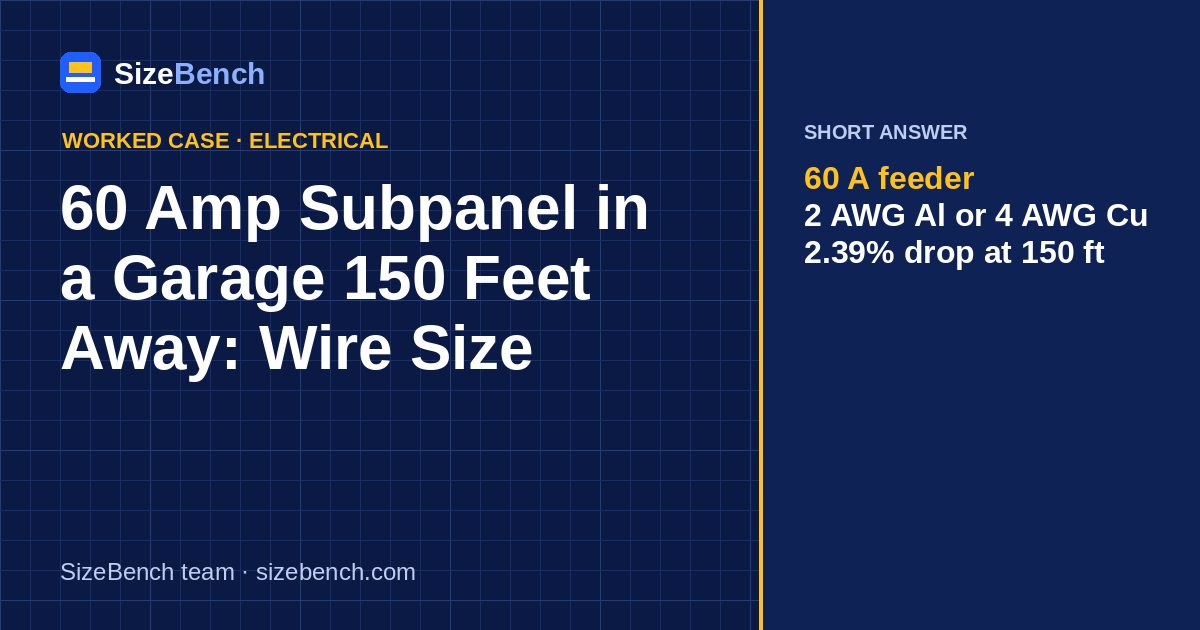
The case: a 60 A, 120/240 V subpanel in a detached two-car garage, fed from a 60 A two-pole breaker in the house panel. The trench is 150 ft one-way. Planned loads: lighting, receptacles, a 240 V air compressor and an occasional small welder.
Short answer: 2 AWG aluminum (or 4 AWG copper) for the two hots and the neutral, plus an equipment grounding conductor, in conduit. At a full 60 A the drop is 2.39% on aluminum and 2.31% on copper. The sizes that only meet ampacity, 6 AWG copper and 4 AWG aluminum, drop 3.7% and 3.8% at this length.

1. Start with ampacity
A 60 A feeder needs conductors rated at least 60 A at the temperature of the terminations, normally 75 °C:
| Conductor | Ampacity at 75 °C | Enough for 60 A? |
|---|---|---|
| 6 AWG copper | 65 A | Yes |
| 8 AWG copper | 50 A | No |
| 4 AWG aluminum | 65 A | Yes |
| 6 AWG aluminum | 50 A | No |
If the garage were 40 ft away, 6 AWG copper or 4 AWG aluminum would finish the job. At 150 ft they do not.
2. Voltage drop at 150 feet
For a 120/240 V feeder the drop on a 240 V load is VD = 2 × L × I × R ÷ 1000, with L the one-way length in feet and R the resistance per 1000 ft. At the full 60 A:
| Feeder | Drop (V) | Drop (%) | Voltage at the garage |
|---|---|---|---|
| 6 AWG copper | 8.8 V | 3.68% | 231.2 V |
| 4 AWG copper | 5.5 V | 2.31% | 234.5 V |
| 4 AWG aluminum | 9.1 V | 3.81% | 230.9 V |
| 2 AWG aluminum | 5.7 V | 2.39% | 234.3 V |
The NEC's informational notes suggest about 3% on a feeder and 5% for feeder plus branch circuit combined. Using 3% on the feeder leaves 2% for the circuits inside the garage, which matters because the far wall of a garage can be another 40 ft of 12 AWG.
3. How much of the 60 amps will you really use?
A 60 A breaker is a ceiling, not a constant load. Below are the drops at 150 ft for several currents, so you can judge your own mix. Our stated assumption for a busy afternoon is about 48 A: a compressor running, the lights, a space heater and a battery charger.
| Load on the feeder | 6 AWG Cu | 4 AWG Cu | 4 AWG Al | 2 AWG Al |
|---|---|---|---|---|
| 20 A | 1.23% | 0.77% | 1.27% | 0.80% |
| 30 A | 1.84% | 1.16% | 1.91% | 1.20% |
| 40 A | 2.46% | 1.54% | 2.54% | 1.59% |
| 48 A | 2.95% | 1.85% | 3.05% | 1.91% |
| 60 A | 3.68% | 2.31% | 3.81% | 2.39% |
If the garage will only ever see lights and a few tools, 6 AWG copper stays just under 3% up to about 48 A. The moment a welder or a heater is on the list, the upsized feeder pays for itself in tools that start cleanly.
4. Distance table for a 60 amp feeder
Smallest size that carries 60 A and meets the stated drop at a full 60 A on 240 V:
| One-way length | Copper, 3% | Drop | Aluminum, 3% | Drop | Aluminum, 5% | Drop |
|---|---|---|---|---|---|---|
| 50 ft | 6 AWG | 1.23% | 4 AWG | 1.27% | 4 AWG | 1.27% |
| 100 ft | 6 AWG | 2.46% | 4 AWG | 2.54% | 4 AWG | 2.54% |
| 150 ft | 4 AWG | 2.31% | 2 AWG | 2.39% | 4 AWG | 3.81% |
| 200 ft | 3 AWG | 2.45% | 1 AWG | 2.53% | 3 AWG | 4.03% |
| 250 ft | 2 AWG | 2.43% | 1/0 AWG | 2.51% | 2 AWG | 3.99% |
Aluminum is the usual choice for long feeders: the larger size is lighter, easier to pull and widely available as individual XHHW-2 conductors or as direct-burial cable. Its terminations must be on lugs marked AL/CU, with antioxidant compound where the lug maker calls for it.

5. Four wires, two grounding jobs
A detached garage is a separate building, and the NEC treats the feeder differently from a branch circuit:
- Four conductors. Two hots, an insulated neutral and an equipment grounding conductor. The old practice of three wires with the neutral re-bonded at the outbuilding is no longer allowed for new work.
- Neutral and ground separated in the garage panel. Remove or do not install the bonding screw or strap; neutral bars float, ground bars bond to the enclosure.
- A grounding electrode at the garage, typically ground rods, connected to the subpanel's ground bar.
- A disconnect at the garage. A subpanel with a 60 A main breaker is the cleanest way to provide it.
The equipment grounding conductor for a 60 A feeder starts at 10 AWG copper or 8 AWG aluminum. Because the hots were upsized for voltage drop, the ground grows in proportion: the copper area ratio is 1.59 and the aluminum ratio is 1.58, which puts the ground at 8 AWG copper or 6 AWG aluminum in this case.
6. Can the house panel spare 60 amps?
The feeder breaker size and the house's service capacity are two different questions. A 60 A breaker protects the feeder; it does not reserve 60 A of the service. What matters is the NEC load calculation for the whole dwelling, in which the garage's real loads are added to the house's. Many 200 A homes absorb a garage subpanel easily; a 100 A home with an electric range, dryer and central air may not. Before you dig, list the garage loads with their nameplate amps and ask the electrician to run the calculation.
Check one more thing in the house panel: a two-pole space and a breaker type listed for that panel. Tandem or "cheater" breakers are only allowed where the panel label permits them.
7. Trench and raceway choices
- PVC conduit with individual conductors. The most flexible option: you can pull larger wire later, or add a spare conduit for data at the same time.
- Direct-burial aluminum cable. Fast to install over long runs; protect it in conduit where it rises out of the ground.
- Burial depth depends on the method and on whether the trench crosses a driveway. Ask the inspector before you rent the trencher.
- Pull boxes are worth it if the route has more than a few bends; 150 ft of 2 AWG pulls easily on a straight run, not through four elbows.
8. Reading the subpanel label
- Bus rating (for example 100 A or 125 A): it may be larger than the feeder breaker; that is fine.
- Main breaker or "main lug only": with a 60 A main in the garage panel, you have the building disconnect.
- Lug range and material: confirm the main lugs accept 2 AWG aluminum and are marked AL/CU.
- Number of spaces: buy more than you think. A 12- or 20-space panel costs little more than a 6-space one.
9. Inspection checklist
- [ ] 60 A two-pole breaker at the house, listed for that panel
- [ ] 2 AWG Al or 4 AWG Cu hots and neutral; ground upsized in proportion
- [ ] Conduit or direct-burial cable at the depth required for the method; warning tape in the trench
- [ ] Neutral isolated from ground at the subpanel
- [ ] Ground rods at the garage, bonded to the subpanel ground bar
- [ ] Main breaker or other disconnect at the garage
- [ ] GFCI protection on garage receptacles
10. Signs the feeder is undersized
- The compressor groans on start and trips its own overload in summer.
- Lights dim visibly when a 240 V tool starts.
- A welder's arc is unstable at settings that work fine elsewhere.
- Lugs or the feeder breaker run warm. Check torque first, then the feeder size.
11. Common mistakes
- Sizing the feeder for the breaker only. 6 AWG copper is legal for 60 A and drops 3.7% at 150 ft.
- Three-wire feeders. New feeders to a separate building need a separate ground.
- Bonding neutral and ground in the subpanel. It puts neutral current on the ground path and on metal parts.
- Skipping ground rods because "the ground comes from the house."
- Aluminum on copper-only lugs. Check the marking on every termination.
Case summary
| Item | Result |
|---|---|
| Feeder breaker | 60 A two-pole at the house |
| Hots and neutral | 2 AWG Al or 4 AWG Cu |
| Ground | 6 AWG Al or 8 AWG Cu |
| Drop at 60 A | 2.39% (Al), 2.31% (Cu) |
| Garage panel | Main breaker, neutral isolated, ground rods |
FAQ
Is 6 gauge copper OK for a 60 amp subpanel 150 feet away? It is legal on ampacity but drops 3.68% at a full 60 A. At 48 A it drops 2.95%. Go to 4 AWG copper for a shop.
What size aluminum wire for a 60 amp subpanel at 150 feet? 2 AWG aluminum, which drops 2.39% at 60 A.
Will a welder work on this feeder? A small 240 V welder drawing about 30 A drops only 1.20% on 2 AWG aluminum. The limit will be the welder's own breaker, not the feeder.
Can I just run a 60 amp circuit without a subpanel? A single circuit to an outbuilding is allowed, but you lose the separate breakers for lights and outlets. A subpanel is the practical answer.
What about 200 feet? Under 3% at full load, 3 AWG copper or 1 AWG aluminum.
Different distance or load? Run the wire size calculator with your numbers, and have a licensed electrician pull the permit before you dig.
Try it with your own numbersWire Size Calculator→Sources and references
- NFPA 70, National Electrical Code (NEC) feeder ampacity tables, equipment grounding conductor sizing and proportional upsizing, rules for feeders to separate buildings (disconnect, grounding electrode, separate neutral and ground)
- Electrical Safety Foundation International (ESFI) homeowner guidance on permits, overloaded circuits and working with licensed electricians
- OSHA – Electrical safety background on grounding and shock hazards from improper equipment grounding
- SizeBench wire size calculator the same ampacity and voltage-drop math used in this guide
Standards and data behind our calculators
How we made this guide
Every number in this guide is calculated by the same code as our calculators, from the standards listed above, and the page is tested before publication. The SizeBench team researched, wrote and reviewed it; we use automation and AI tools to help draft, never to produce the figures. Our methodology →
Revision history
- · Published