The case: a straight 100 ft line of 6 ft cedar privacy fence with pressure-treated 4x4 posts every 8 ft. That is 14 posts, counting both ends. Each hole is dug 10 in wide and 3 ft deep with a two-person auger. The frost line in this county is under 3 ft.
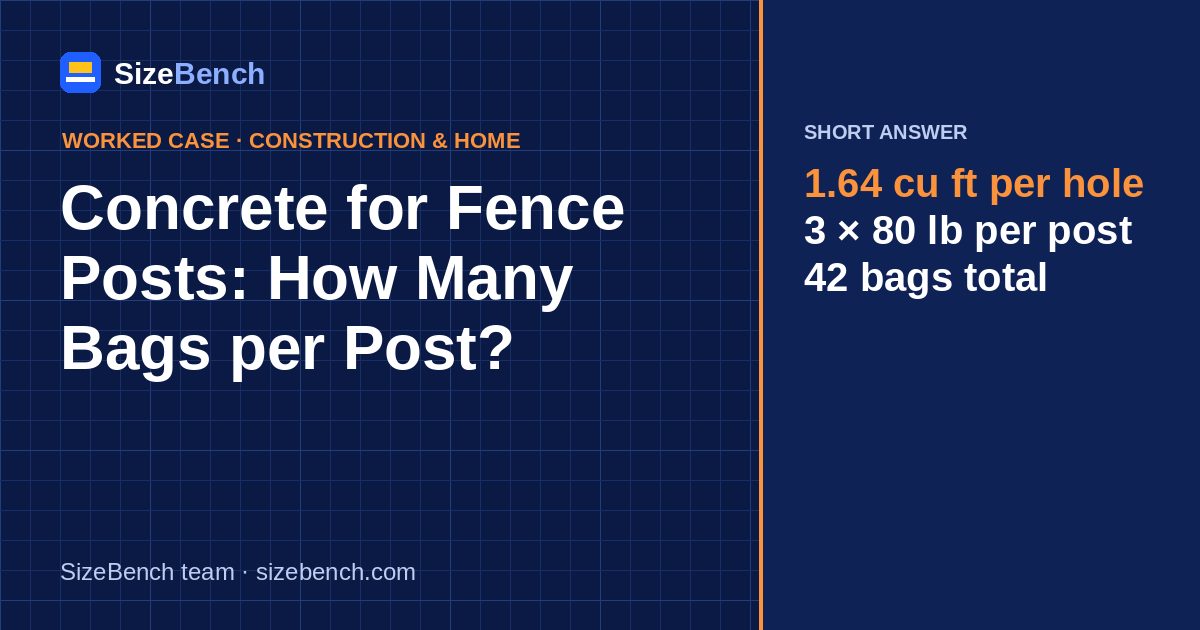
Short answer: each hole holds 1.64 cu ft, or 1.80 cu ft with a 10% allowance. That is 3 bags of 80 lb per post. For all 14 posts the calculator gives 25.2 cu ft = 42 bags of 80 lb (56 of 60 lb, 84 of 40 lb). Gravel in the bottom of each hole and the post itself take up some space, which leaves a small margin.

1. A post hole is a cylinder
The calculator's column mode treats each hole as a cylinder. The diameter is in inches, so it is divided by 24 to get the radius in feet:
Volume = π × (10 ÷ 24)² × 3 ft = 1.636 cu ft per hole
With 10%: 1.636 × 1.10 = 1.80 cu ft → 1.80 ÷ 0.60 = 3.00 → 3 bags of 80 lb
Augered holes are rarely perfect cylinders. They bell out at the top where the soil crumbles and narrow toward the bottom. The 10% allowance absorbs most of that.
2. Bags per post by hole size and depth
The rule of thumb is a hole about three times the post width: 10 to 12 in for a 4x4, and 12 in or more for a 6x6. Depth is usually a third to a half of the post's height above ground, and below the frost line where the ground freezes.
| Hole | 2 ft deep | 2.5 ft deep | 3 ft deep |
|---|---|---|---|
| 8 in | 2 bags (0.70 cu ft) | 2 bags (0.87 cu ft) | 2 bags (1.05 cu ft) |
| 10 in | 2 bags (1.09 cu ft) | 3 bags (1.36 cu ft) | 3 bags (1.64 cu ft) |
| 12 in | 3 bags (1.57 cu ft) | 4 bags (1.96 cu ft) | 5 bags (2.36 cu ft) |
Bags are 80 lb, rounded up per hole, including 10%. Cubic feet are net hole volume.
Diameter matters more than depth. Volume grows with the square of the diameter, so a 12 in hole holds 1.44 times as much as a 10 in hole. Depth adds volume only in a straight line.
3. Bags for the whole fence
| Fence length (8 ft spacing) | Posts | Concrete with 10% (cu ft) | 80 lb bags | 60 lb bags |
|---|---|---|---|---|
| 50 ft | 8 | 14.4 | 24 | 32 |
| 100 ft | 14 | 25.2 | 42 | 56 |
| 150 ft | 20 | 36.0 | 60 | 80 |
| 200 ft | 26 | 46.8 | 78 | 104 |
Corners, ends and gates each add a post, and gate posts usually get a larger hole. Walk the line and count the actual posts before you buy.
4. Refinements: gravel and the post itself
The calculator gives the full hole, which is the safe number to buy. Two things take up part of that space:
| Item per hole | Volume (cu ft) |
|---|---|
| Full 10 in × 3 ft hole | 1.636 |
| Minus 6 in of gravel at the bottom | −0.273 |
| Minus the buried part of a 4x4 (3.5 × 3.5 in) | −0.255 |
| Concrete actually placed | 1.108 |
That is 1.85 bags of 80 lb per post. For the whole run, 26 bags instead of 42. Buy the larger figure anyway: oversized hole tops and a few extra-deep holes use up the difference, and unopened bags can usually be returned.

5. Wet mix or dry-set?
There are two ways to set posts with bagged concrete:
- Mixed concrete. Mix in a wheelbarrow to the bag's water ratio, fill around the plumbed post, and crown the top so water runs away from the wood. This gives the strongest, most predictable footing.
- Fast-setting post mix. Pour the dry mix into a hole partly filled with water. It sets in well under an hour. It is convenient for a long run, but check its yield per bag, which is often lower than standard mix, and redo the count.
Either way, brace each post plumb in two directions until the concrete sets, and wait the time on the bag before hanging rails and pickets.
6. Logistics: 42 bags is a lot of weight
42 bags of 80 lb is 3,360 lb (1,524 kg) of dry mix. That is more than most half-ton pickups should carry in one load, so plan two trips or have the bags delivered on a pallet. Stage them along the fence line, 3 beside each hole, under a tarp, so nobody carries a bag farther than it needs to go.
Work in a rhythm. Dig all the holes first, then set the corner and end posts and run a string line between them, then set the line posts to the string. Mixing 3 bags per hole in a wheelbarrow takes a few minutes per post, so a two-person crew can comfortably set the whole run in a day once the holes are dug. Unlike a patio slab, there is no cold joint to worry about: each footing is its own small pour.
Water matters too. Each bag needs a few quarts, and the exact amount depends on the product, so check the label. Bring a hose or enough buckets for the 42 bags, and do not add water beyond the label to make mixing easier.
7. Reading the bag label
- Product. "Concrete mix" or "post-setting mix". Mortar and sand mixes are not for footings.
- Yield (cu ft). The number this whole estimate depends on: 0.60 for most 80 lb bags of standard mix.
- Set time. Standard mix needs a day or more before loading; fast-setting post mix is ready much sooner.
- Water per bag. Follow it for strength.
8. Hole and post checklist
- [ ] Utility locate requested through 811 a few days before digging
- [ ] Property line confirmed and any permit or HOA height limits checked
- [ ] Hole depth below the local frost line (ask the building department)
- [ ] 4 to 6 in of gravel in the bottom for drainage
- [ ] Posts rated for ground contact, cut ends treated
- [ ] Concrete crowned at the top, sloping away from the post
- [ ] 42 bags of 80 lb on site for this run
9. Signs of a footing problem
- The post leans after the first windy season. The hole was too shallow or narrow for a 6 ft privacy panel, or the soil is soft. Gate posts show it first.
- The post heaves up in spring. Frost is lifting a footing that does not reach below the frost line, or one that is wider at the top than at the bottom.
- The wood rots at grade within a few years. Water is pooling on a flat or dished concrete top. Crown it, and keep soil and mulch below the top of the concrete.
10. Common mistakes
- Forgetting the post count includes both ends. 100 ft at 8 ft spacing is 13 bays but 14 posts.
- Mixing up radius and diameter. Using 10 in as the radius quadruples the answer.
- Pouring concrete under the post end. It traps water in a cup around the end grain. Set the post on gravel instead.
- Digging holes wider at the top than at the bottom. A cone-shaped footing is exactly what frost pushes upward.
FAQ
How many bags of concrete per fence post? For a 4x4 in a 10 in × 3 ft hole, 3 bags of 80 lb, or 4 bags of 60 lb.
How many 50 lb bags per post? Use the yield printed on the bag. Divide the 1.80 cu ft per hole by that yield and round up.
How deep should a 6 ft fence post be? A common guideline is a third to a half of the exposed height, here 2 to 3 ft, and always below frost depth. A 3 ft hole takes 3 bags at 10 in diameter.
What about 6x6 posts in 12 in holes? A 12 in × 3 ft hole holds 2.36 cu ft, which is 5 bags of 80 lb per post.
Should I just use gravel instead of concrete? Compacted gravel drains well and suits some soils and fence types. A 6 ft privacy fence in wind is usually set in concrete.
Case summary
| Item | Result |
|---|---|
| Fence | 100 ft, 6 ft privacy, 4x4 posts every 8 ft (14 posts) |
| Hole | 10 in diameter × 3 ft |
| Per hole | 1.64 cu ft (1.80 with 10%) → 3 × 80 lb |
| Whole fence | 25.2 cu ft → 42 × 80 lb, 56 × 60 lb or 84 × 40 lb |
| Net after gravel and post | 1.11 cu ft per hole |
Different hole size or more posts? Switch the concrete calculator to column mode and enter the diameter, depth and number of holes.
Try it with your own numbersConcrete Calculator→Sources and references
- SizeBench concrete calculator the column formula π × (d ÷ 24)² × depth, the 10% waste allowance and bag yields of 0.60, 0.45 and 0.30 cu ft
- Portland Cement Association (PCA) general guidance on mixing, placing and curing concrete, described in words
- Call 811 – Know what's below the free utility-locate request before digging post holes
- USDA Forest Service, Forest Products Laboratory decay resistance of preservative-treated wood in ground contact, described in words
Standards and data behind our calculators
How we made this guide
Every number in this guide is calculated by the same code as our calculators, from the standards listed above, and the page is tested before publication. The SizeBench team researched, wrote and reviewed it; we use automation and AI tools to help draft, never to produce the figures. Our methodology →
Revision history
- · Published