The case: a freestanding electric range rated 11.8 kW at 240 V, whose installation manual specifies a 50 A circuit. The cable runs 35 ft from the panel. The house wiring method is NM-B cable.
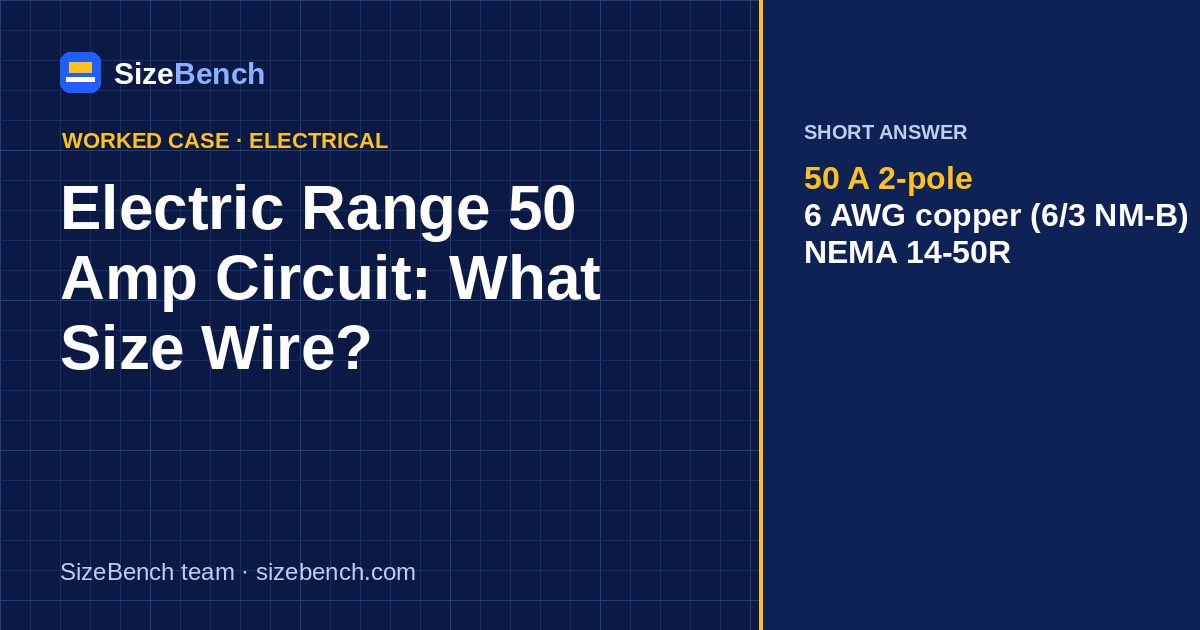
Short answer: a 50 A two-pole breaker, 6/3 NM-B copper with ground (6 AWG hots and neutral), and a NEMA 14-50R four-wire receptacle, or a hardwired connection. 8 AWG would only be acceptable as THHN in conduit, and the NEC demand for this range (33.3 A) would even allow a 40 A circuit if the manual permitted it.

1. Nameplate amps versus real current
If every element and the oven ran flat out at once, the range would draw:
11,800 W ÷ 240 V = 49.2 A
That never happens in practice. Surface elements cycle, the oven thermostat cycles, and nobody runs all burners on high with the oven at broil for long. That is why the NEC lets you size range circuits with a demand factor instead of the nameplate.
2. The NEC demand for one range
For a single household range rated up to 12 kW, the NEC uses a demand of 8 kW. Above 12 kW the 8 kW grows by 5% for each additional kilowatt (or part of one). For our range:
Demand = 8.0 kW → 8,000 W ÷ 240 V = 33.3 A
| Range nameplate | Nameplate amps | NEC demand | Demand amps | Minimum circuit by code |
|---|---|---|---|---|
| 8.0 kW | 33.3 A | 8.0 kW | 33.3 A | 35 A |
| 10.0 kW | 41.7 A | 8.0 kW | 33.3 A | 40 A |
| 11.8 kW | 49.2 A | 8.0 kW | 33.3 A | 40 A |
| 14.0 kW | 58.3 A | 8.8 kW | 36.7 A | 40 A |
| 16.0 kW | 66.7 A | 9.6 kW | 40.0 A | 40 A |
The last column already includes a floor the NEC sets: a range of 8¾ kW or more needs a branch circuit of at least 40 A. So code alone would accept a 40 A circuit for our range. The installation manual wins when it asks for more, and many ranges, especially induction models, ask for 50 A. A listed appliance installed against its instructions is a code violation too.
3. Wire for a 50 A range circuit
| Wiring method | Smallest copper for 50 A | Rating |
|---|---|---|
| NM-B cable (60 °C column) | 6 AWG (6/3 with ground) | 55 A |
| THHN in conduit, 75 °C terminals | 8 AWG | 50 A |
| 8/3 NM-B | not allowed on 50 A | 40 A |
In most homes the range is fed with NM-B through joists, so the answer is 6/3 NM-B. 8/3 NM-B is the right cable for a 40 A range circuit, which is what many older kitchens have. If the new range asks for 50 A and the existing cable is 8/3, the cable has to be replaced, not just the breaker.
4. Voltage drop is rarely the issue
We assume a realistic heavy-cooking peak of 36 A: oven baking plus two large burners. At 35 ft the drop is 0.52% on 6 AWG and 0.80% on 8 AWG. Distance only starts to matter in long ranch houses or additions:
| One-way length | Calculator pick, 50 A at 3% | 6 AWG at 36 A | 8 AWG at 36 A |
|---|---|---|---|
| 25 ft | 8 AWG | 0.37% | 0.57% |
| 50 ft | 8 AWG | 0.74% | 1.15% |
| 75 ft | 8 AWG | 1.10% | 1.72% |
| 100 ft | 6 AWG | 1.47% | 2.29% |
| 125 ft | 6 AWG | 1.84% | 2.87% |
The calculator column shows the conduit (75 °C) minimum at a full 50 A. With NM-B, 6 AWG is the minimum regardless, and it stays under 3% at the realistic peak well past 100 ft.

5. Receptacle or hardwire
- NEMA 14-50R, four wire: two hots, neutral, ground. This is the standard for new range circuits. The range gets a four-wire 50 A range cord, and the neutral-to-frame bond inside the range is removed, as the manual describes.
- Hardwired: the range's flexible conduit whip lands in a junction box. Common with cooktops and wall ovens, less so with freestanding ranges.
- NEMA 10-50R, three wire, belongs to older installations and is not used for new circuits.
Choose a range receptacle that fits behind the drawer: surface-mount boxes can keep the range from sliding back flush. Install the anti-tip bracket that ships with the range; tip-over injuries with open oven doors are a known hazard.
6. Reading the range's rating plate
The plate is usually behind the storage drawer or on the oven frame. Look for:
- kW at 240 V and at 208 V. Apartments on 208 V see less power from the same range.
- Minimum circuit size, sometimes written as "use 40 A or 50 A circuit". If both are listed, either is allowed.
- Cord rating if a cord is required: buy a 40 A or 50 A cord to match the receptacle.
7. Cooktop plus wall oven instead of a range
Remodels often split the range into a counter-mounted cooktop and a wall oven. The wiring changes:
- Separate circuits are the simple route: each appliance gets the breaker and cable its own manual asks for. Cooktops often ask for 40 A and single wall ovens for 20 or 30 A, but the numbers vary by model. Read both manuals before you order cable.
- One circuit for both is allowed when they are in the same room and the combined rating is treated like a single range for the demand calculation. Each appliance is then connected with tap conductors sized for that appliance. It saves a breaker space but makes the job harder to inspect and to change later.
- Induction cooktops often specify a 40 A or 50 A circuit even though they waste less heat. Their peak draw with several zones on boost can be close to the nameplate for short periods, and their electronics are less tolerant of loose connections than a coil element.
Whatever the layout, the cable to each appliance follows the same rule as above: NM-B sized from the 60 °C column, copper, with a neutral when the appliance needs 120 V for controls.
8. Induction ranges and 208 V buildings
Induction ranges are the usual reason a remodel moves from 40 A to 50 A. They pull close to nameplate when several zones run on boost, and their manuals tend to be strict about circuit size. In condos and apartments fed at 208 V, check the 208 V column of the rating plate: resistance elements lose about a quarter of their power at 208 V, and the manual may list a different circuit size for that voltage.
9. How much energy does a range use?
The demand factor tells you about wiring, not your bill. As an example, assume about 1.0 hour of cooking a day at an average 2.5 kW (elements cycling). That is 2.5 kWh per day, roughly 75 kWh per month. Your own habits will move that number more than any wire choice.
10. Installation checklist
- [ ] Breaker matches the manual: 50 A two-pole here (40 A if the manual allows)
- [ ] 6/3 NM-B copper with ground for 50 A; 8/3 only for 40 A
- [ ] NEMA 14-50R, four wire, in a box sized for 6 AWG conductors
- [ ] Four-wire range cord, neutral-to-frame bond removed
- [ ] Anti-tip bracket installed and engaged
- [ ] Measured: about 240 V hot to hot, about 120 V each hot to neutral
11. Signs of a problem
- Oven heats but some burners are weak, or the reverse: often a lost hot leg or a loose terminal at the receptacle.
- Burn marks on the plug blades. Replace receptacle and cord end together.
- The breaker trips only on self-clean. Self-clean is the longest high-heat cycle; it exposes a weak breaker or a loose connection.
12. Common mistakes
- Upgrading the breaker from 40 A to 50 A on existing 8/3 cable. The cable is rated 40 A.
- Sizing from nameplate amps. 49.2 A suggests a 60 A circuit nobody needs.
- Reusing a three-wire cord on a new four-wire receptacle.
- Ignoring the manual's minimum. It overrides the demand calculation when it asks for more.
Case summary
| Item | Result |
|---|---|
| Range | 11.8 kW, NEC demand 8.0 kW (33.3 A) |
| Breaker | 50 A two-pole (per manual) |
| Wire | 6/3 NM-B copper with ground |
| Receptacle | NEMA 14-50R |
| Drop at 36 A, 35 ft | 0.52% |
FAQ
What size wire for a 50 amp range? 6 AWG copper in NM-B cable (rated 55 A). In conduit with 75 °C terminations, 8 AWG THHN is also allowed.
Can I put my range on a 40 amp breaker? If the manual allows 40 A, yes: the NEC demand for a 11.8 kW range is 33.3 A. Use 8/3 copper with ground.
Is 6/3 or 6/2 for a range? 6/3 with ground. The range's clock, lights and controls run at 120 V and need the neutral.
Does a bigger range need a bigger circuit? A 16 kW range has an NEC demand of 9.6 kW, 40.0 A, still inside a 50 A circuit.
Planning a different appliance or a longer run? Check it in the wire size calculator before you buy cable.
Try it with your own numbersWire Size Calculator→Sources and references
- NFPA 70, National Electrical Code (NEC) demand factors for household cooking appliances, NM-B ampacity in the 60 °C column, four-wire requirement for new range circuits
- U.S. Department of Energy – Estimating appliance and home electronic energy use method for turning wattage and hours of use into kWh
- U.S. Consumer Product Safety Commission range tip-over and appliance safety information
- SizeBench wire size calculator the ampacity and voltage-drop math used in this guide
Standards and data behind our calculators
How we made this guide
Every number in this guide is calculated by the same code as our calculators, from the standards listed above, and the page is tested before publication. The SizeBench team researched, wrote and reviewed it; we use automation and AI tools to help draft, never to produce the figures. Our methodology →
Revision history
- · Published