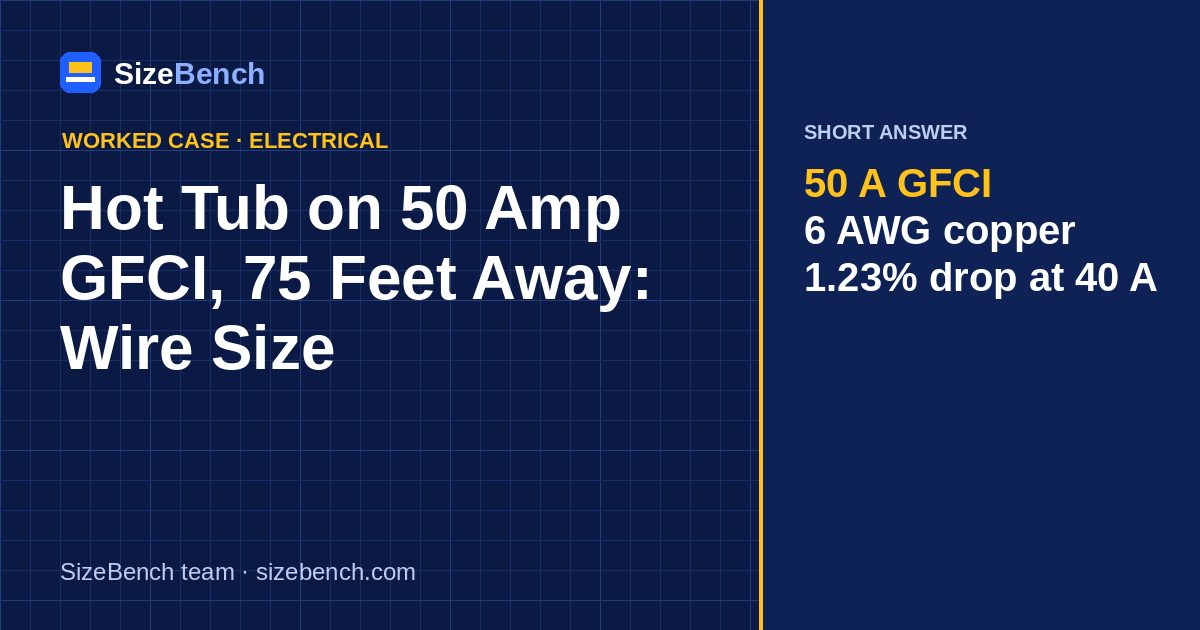
The case: a 240 V hot tub whose manual requires a 50 A GFCI-protected supply with four wires (two hots, neutral, ground). The house panel is 75 ft from the spa disconnect, which will stand 6 ft from the tub. Copper conductors in PVC conduit.
Short answer: a 50 A two-pole breaker in the house panel feeding a 50 A GFCI spa disconnect, with 6 AWG copper hots and neutral plus an insulated copper ground. On paper 8 AWG THWN-2 carries 50 A and drops 2.39% at full load, but 6 AWG keeps the drop at 1.23% under a realistic 40 A and matches what most spa manuals specify.

1. What a 50 A hot tub really draws
A 50 A rating is the maximum the spa's controller can ask for, with every pump on high, the blower running and the heater on. Typical numbers from a manual like ours:
- Heater: 5.5 kW at 240 V, so 22.9 A.
- Jet pumps, circulation pump, blower, lights, controls: about 14 A combined at their worst (our assumption).
Many controllers lock out the heater when the jets run on high, which keeps the real peak lower. We use 40 A as a realistic heavy-use figure and 50 A as the worst case.
2. Ampacity first
| Conductor in conduit | Ampacity at 75 °C | OK for 50 A? |
|---|---|---|
| 8 AWG copper THWN-2 | 50 A | Yes, at the limit |
| 6 AWG copper THWN-2 | 65 A | Yes |
| 6/3 UF-B cable (60 °C) | 55 A | Yes, if allowed for the location |
For a spa, the NEC requires the equipment grounding conductor to be insulated copper, run with the circuit conductors. That rules out most cable types for the final run near the tub, and it is why individual THWN-2 conductors in PVC conduit are the norm.
3. Voltage drop over 75 feet
| Copper size | Drop at 50 A | Drop at 40 A | Volts at the tub (40 A) |
|---|---|---|---|
| 8 AWG | 2.39% | 1.91% | 235.4 V |
| 6 AWG | 1.53% | 1.23% | 237.1 V |
| 4 AWG | 0.96% | 0.77% | 238.2 V |
The calculator's pick for 50 A under 3% is 8 AWG, so 8 AWG is technically enough. Two reasons push most installers to 6 AWG anyway: the tub's heater can run for hours on a cold night, and many spa manuals list 6 AWG copper as the minimum for a 50 A supply. If the manual says 6, it is 6.
4. Distance table
| One-way length | Minimum at 50 A, 3% | 8 AWG at 40 A | 6 AWG at 40 A | 4 AWG at 40 A |
|---|---|---|---|---|
| 25 ft | 8 AWG | 0.64% | 0.41% | 0.26% |
| 50 ft | 8 AWG | 1.27% | 0.82% | 0.51% |
| 75 ft | 8 AWG | 1.91% | 1.23% | 0.77% |
| 100 ft | 6 AWG | 2.55% | 1.64% | 1.03% |
| 125 ft | 6 AWG | 3.18% | 2.05% | 1.28% |
| 150 ft | 4 AWG | 3.82% | 2.46% | 1.54% |
At around 150 ft, move to 4 AWG copper, or run an aluminum feeder to a small subpanel near the tub and make the last run in copper as the manual requires.

5. Where the GFCI disconnect goes
The NEC requires a disconnect for the spa that is within sight of the tub and at least 5 ft horizontally from its inside wall, unless a permanent barrier forces a longer reach path. In practice:
- Mount the spa disconnect (a small outdoor panel with a 50 A GFCI breaker) 5 to 10 ft from the tub, on a post or the house wall.
- The GFCI can be in the house panel instead, but then you still need a disconnect near the tub, and resetting a trip means walking back to the house.
- Use the neutral: a 50 A GFCI breaker for a four-wire spa has a neutral terminal and a white pigtail. The spa's 120 V controls depend on it.
6. Bonding and the ground
Two different things often get confused:
- Equipment grounding: the insulated copper ground in the conduit, connected to the spa's ground lug. It carries fault current back to the panel so breakers trip. The minimum for a 50 A circuit is 10 AWG copper, but when the hots are upsized from the 8 AWG minimum to 6 AWG (an area ratio of 1.59), the ground must grow in proportion, to 8 AWG insulated copper.
- Bonding: connecting the metal parts around the tub (and in some cases the deck reinforcing) so they sit at the same voltage. Listed self-contained spas have simplified rules, but metal railings, fences or equipment close to the tub may still need it. Ask your inspector before you pour the slab.
7. House breaker and spa panel: how they work together
There are two common layouts:
- Breaker at the house, GFCI at the tub. A plain 50 A two-pole breaker in the house panel protects the 75 ft run; the spa disconnect holds the 50 A GFCI breaker that protects the tub. This is the layout in our case and the easiest to live with: a GFCI trip is reset next to the tub.
- GFCI at the house, switch at the tub. The GFCI breaker sits in the house panel and a non-fused disconnect stands near the tub. It saves a breaker, but every nuisance trip means a walk to the basement.
If you want room for a future pool pump or patio lighting circuit, make the outdoor box a small subpanel with a main feeder breaker, a 50 A GFCI for the spa and spare spaces. The feeder is then sized for the subpanel rating, and the 6 AWG copper with 75 °C terminations (65 A) gives you headroom.
8. Conduit and trench
Four conductors of this size pull easily through 1-inch PVC; smaller conduit works on paper but makes a 75 ft pull with bends hard work. Use Schedule 80 where the conduit rises out of the ground and could be hit by a mower or a shovel. Add a pull box if the route has more than a few bends, and lay warning tape in the trench above the conduit.
9. Energy use
Electrical sizing is for the worst hour; the bill depends on the average. Assume the heater runs about 3 hours a day in winter: 5.5 kW × 3 h = 16.5 kWh per day, plus the circulation pump. A good insulated cover is worth more than any wire size here.
10. Reading the spa's label
- Voltage and frequency: 240 V, 60 Hz; some tubs can be converted to 120 V "plug and play", which is a different, much weaker setup.
- Required supply: "50 A GFCI, 4 wire" or similar.
- Wire size and material: usually "copper only" with a minimum gauge.
- Terminal block range: confirm it accepts 6 AWG.
11. Installation checklist
- [ ] 50 A two-pole breaker at the house, rated for the panel
- [ ] 6 AWG copper hots and neutral, 8 AWG insulated copper ground, all in PVC conduit
- [ ] 50 A GFCI disconnect at least 5 ft from the tub, within sight
- [ ] Conduit buried at the depth required for the method, sealed fittings at the tub
- [ ] Bonding done where the inspector requires it
- [ ] GFCI test button tested after power-up
12. Signs of a problem
- The GFCI trips when the heater starts: usually a failing heater element or moisture in a connection, not an undersized wire.
- Lights flicker when the jets kick in: check torque on the disconnect lugs and measure voltage under load.
- The heater takes much longer than usual to recover: measure voltage at the tub; a sag below about 228 V points to the feed or a loose connection.
13. Common mistakes
- Three-wire feed to a four-wire tub. No neutral, no controls.
- Bare ground in the conduit. Spa grounds must be insulated copper.
- Disconnect within 5 ft of the water.
- Sizing for the breaker only on long runs. At 150 ft, 8 AWG drops 3.82% at 40 A.
Case summary
| Item | Result |
|---|---|
| Supply | 120/240 V, four wire |
| House breaker | 50 A two-pole |
| Spa disconnect | 50 A GFCI, 5 to 10 ft from the tub |
| Conductors | 6 AWG copper + 8 AWG insulated copper ground |
| Drop at 40 A, 75 ft | 1.23% |
FAQ
What size wire for a 50 amp hot tub 75 feet away? 6 AWG copper. It drops 1.53% at a full 50 A and 1.23% at 40 A.
Can I use 8 gauge wire for a 50 amp hot tub? As THWN-2 in conduit it is rated 50 A, so it can be legal, but only if the spa manual allows it. Most specify 6 AWG.
Does the hot tub need a neutral? Most 240 V tubs with 120 V controls or lighting do. Check the label for "4 wire".
Can I use aluminum wire for the hot tub? For the long feeder to a subpanel near the tub, aluminum is common. The final run to the tub follows the manual, which almost always says copper.
Different tub or longer run? Check it in the wire size calculator, and get the permit before the patio is finished.
Try it with your own numbersWire Size Calculator→Sources and references
- NFPA 70, National Electrical Code (NEC) Article 680 requirements for spas and hot tubs (GFCI protection, disconnect location, insulated copper equipment grounding conductor, bonding), conductor ampacity tables
- Pool Safely, U.S. Consumer Product Safety Commission safety guidance for pools and spas, including electrical hazards around water
- NEMA, Ground-Fault Personnel Protection how GFCI devices detect leakage current and protect people
- SizeBench wire size calculator the ampacity and voltage-drop math used in this guide
Standards and data behind our calculators
How we made this guide
Every number in this guide is calculated by the same code as our calculators, from the standards listed above, and the page is tested before publication. The SizeBench team researched, wrote and reviewed it; we use automation and AI tools to help draft, never to produce the figures. Our methodology →
Revision history
- · Published