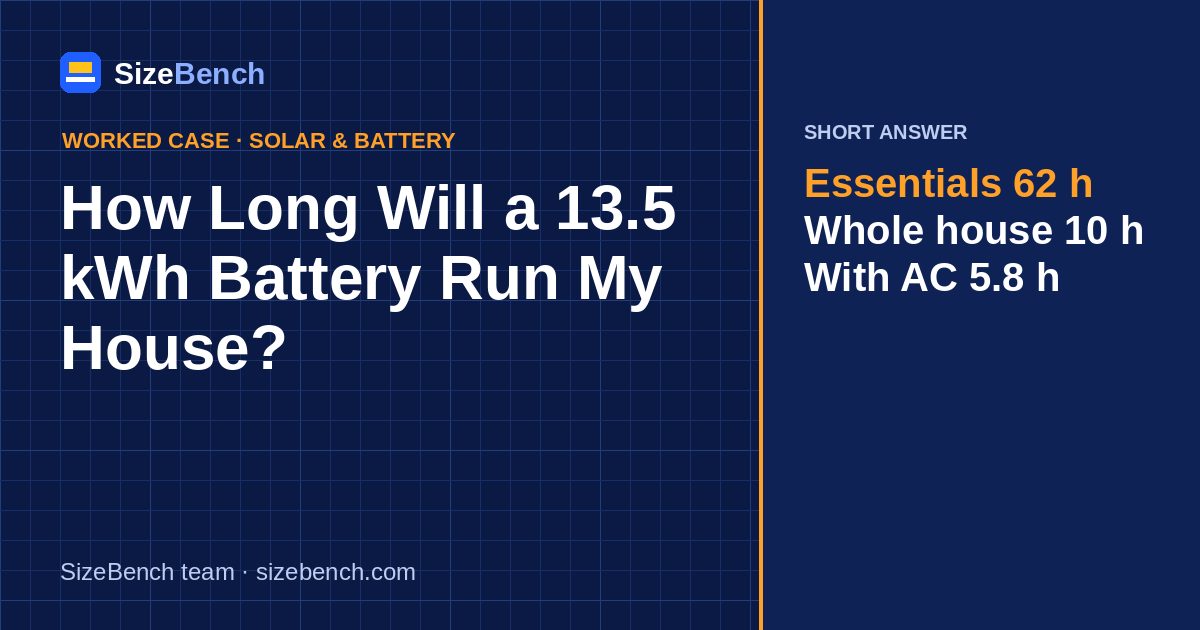
The case: one wall-mounted home battery rated 13.5 kWh of usable energy, fully charged when the grid goes down. We assume 90% of that energy reaches the house after conversion, so 12.15 kWh is available.
Short answer: about 62 hours (nearly 2.6 days) running essentials only; 33 hours if a gas furnace blower is added in winter; 10 hours for an average whole home; and only 5.8 hours with central air conditioning running.

1. The formula
Battery runtime is energy divided by load:
Hours = usable kWh × conversion efficiency ÷ average load in kW
or, in daily terms, days = usable kWh ÷ kWh used per day. The battery's kWh rating is fixed. Everything interesting happens on the load side, which is why the same battery can last ten hours in one house and nearly three days in the next.
About the 90%: integrated home batteries list usable capacity on the spec sheet, and some energy is lost converting DC battery power to AC for the house. We use 90% as a deliberately conservative figure. If your spec sheet gives a round-trip or discharge efficiency, use that instead.
2. Essentials only: what a critical-loads panel carries
Most battery installs back up a separate critical-loads panel rather than the whole house. Here is a typical essentials list, in kWh per day:
| Load | Assumption | kWh/day |
|---|---|---|
| Refrigerator | yellow EnergyGuide label about 500 kWh/yr | 1.40 |
| Chest freezer | about 330 kWh/yr | 0.90 |
| Modem and router | 15 W around the clock | 0.36 |
| LED lighting | 10 bulbs × 9 W × 5 h | 0.45 |
| TV, laptop, phones | evening use | 0.60 |
| Microwave and coffee maker | about 30 min at 1 kW | 0.50 |
| Sump pump | wet week, short cycles | 0.50 |
| Total | 4.71 |
12.15 kWh ÷ 4.71 kWh/day = 2.58 days, or about 62 hours.
The fridge and freezer dominate, and they are the reason to have backup in the first place. USDA guidance quoted on Ready.gov is that a closed refrigerator keeps food safe for about 4 hours and a full freezer for about 48. A battery removes that clock entirely.
3. Adding the furnace blower in winter
A gas furnace still needs electricity for its blower, igniter and controls. A blower drawing around 500 W for 8 hours a day on a cold day adds 4.0 kWh, almost doubling the essentials total to 8.71 kWh/day. Runtime falls to 33 hours.
Two things help: a modern variable-speed blower often draws far less than 500 W, and lowering the thermostat a few degrees shortens run time. Electric resistance heat, a heat pump or an electric water heater is a different story; a single 4.5 kW water heater element would empty the battery in under three hours. Keep those loads off the backed-up panel unless you have several batteries.
4. Whole house, average day
The EIA puts the average US home at roughly 900 kWh a month, about 29.6 kWh/day. Run the whole house normally and the battery lasts:
12.15 ÷ 29.6 × 24 = 9.9 hours
That covers a typical evening-and-night outage. It does not cover a multi-day storm.
5. Whole house with central air conditioning
A 3-ton central air conditioner draws roughly 3.5 kW while running. Six compressor hours on a hot afternoon add 21 kWh, bringing the day to about 50.6 kWh. Runtime: 5.8 hours.
Air conditioning also raises a second question beyond energy: can the battery start the compressor at all? Compressors draw a brief surge several times their running current. Many installers add a soft starter to the condenser so the battery's peak output can handle it.

6. Power limits: kW matters as much as kWh
Energy (kWh) decides how long; power (kW) decides what can run at the same time. Every home battery has a continuous output rating and a short peak rating, both on the spec sheet. If the oven, dryer and air conditioner all ask for power at once, the battery will shut down to protect itself even when it is nearly full.
Read the spec sheet for:
- Usable energy (kWh): the 13.5 in this case.
- Continuous power (kW): the sum of everything that may run together must stay under it.
- Peak or surge power (kW) and its duration: what a motor can draw while starting.
- Backup transition: whether the switch-over is seamless or causes a brief blink that resets clocks.
7. Recharging with solar
With rooftop solar, the battery can refill during the day. A 7 kW array at 4.5 sun hours and 14% losses produces about 27 kWh on an average day, more than enough to refill the battery and run essentials. On a dark winter day at 1.5 sun hours, the same array produces about 9.0 kWh, which still covers most of the essentials list.
Without solar, the battery is a one-shot reserve. Plan the load list accordingly.
8. Two batteries, or a reserve setting
| Setup | Energy delivered | Essentials | Whole house, average |
|---|---|---|---|
| One battery, full | 12.15 kWh | 62 h | 9.9 h |
| One battery, 80% reserve | 9.72 kWh | 50 h | 7.9 h |
| Two batteries, full | 24.30 kWh | 124 h | 19.7 h |
Many owners cycle the battery every day for solar self-consumption and keep only part of it as a backup reserve. If the outage arrives when the battery is sitting at an 80% reserve floor, runtime shrinks in proportion, as the middle row shows. When a storm is forecast, raise the reserve to 100% so the battery tops up from the grid or the panels beforehand.
9. Stretching the runtime during an outage
Small habits move the numbers more than most people expect:
- Keep the fridge and freezer closed. Each door opening lets cold air out and makes the compressor run longer.
- Unplug idle loads. A game console, a second router and a few chargers can add 50 W around the clock, about 1.2 kWh a day, which is a quarter of the essentials list.
- Cook once, in the microwave. It uses a fraction of what an electric oven does for the same meal.
- Run the sump pump and well pump on the backed-up panel, but nothing else with a motor that you do not need.
Trimming the essentials list by 1 kWh a day, to 3.71 kWh, stretches runtime from 62 to about 79 hours.
10. Installation and inspection checklist
- [ ] Critical-loads panel lists only loads you can afford to carry
- [ ] Large resistive loads (water heater, range, dryer, resistance heat) kept off the backed-up panel
- [ ] Battery installed per its listing and the NEC rules for energy storage systems, with the required clearances and labeling
- [ ] Transfer equipment that isolates the house from the grid during an outage
- [ ] Soft starter on central air if it must run on battery
- [ ] Backup reserve setting checked before storm season
- [ ] Owner knows how to read state of charge on the app or display
11. Signs of a problem during an outage
- Battery shuts off while still charged: a power overload, not an energy shortage. Turn off big loads and restart.
- Charge falling much faster than expected: something large is on, often a well pump, electric water heater or space heater.
- No solar recharge during the outage: some systems need the battery to form a local grid before the inverter restarts; check the system status rather than assuming the panels are dead.
12. Common mistakes
- Treating kWh as the only spec. A big battery with a small continuous kW rating will still trip on a kitchen full of appliances.
- Backing up the whole panel with one battery. Every unattended load drains the battery while you sleep.
- Forgetting the reserve setting. A battery set to keep 20% for outages starts the outage at 20%.
FAQ
Will one 13.5 kWh battery run my refrigerator alone? At 1.4 kWh/day, about 8.7 days.
How long overnight with the whole house on? From 6 p.m. at an average load, about 9.9 hours, so the battery would be empty around 4 a.m. Switch off the dryer, oven and air conditioning at the start of the outage and it reaches morning comfortably.
Can it run central air? For roughly 5.8 hours with an average house load added, provided the battery can start the compressor.
How many batteries for three days of essentials without solar? Three days need 14.1 kWh delivered and one battery covers 12.15 kWh, so 2 batteries. With a furnace blower, three days need 26.1 kWh: 3 batteries.
Case summary
| Item | Result |
|---|---|
| Battery | 13.5 kWh usable, 12.15 kWh delivered |
| Essentials (4.71 kWh/day) | 62 h |
| Essentials + furnace (8.71 kWh/day) | 33 h |
| Whole house (29.6 kWh/day) | 9.9 h |
| Whole house + AC (50.6 kWh/day) | 5.8 h |
Different battery, different load list? Put your own numbers in the battery runtime calculator; it uses exactly this formula.
Try it with your own numbersBattery Runtime Calculator→Sources and references
- U.S. Energy Information Administration – electricity use FAQ average US household consumption, used for the whole-house scenario
- U.S. Department of Energy – Estimating appliance and home electronic energy use method for turning wattage and hours into daily kWh
- Ready.gov – Power outages outage preparation and food-safety timing
- NFPA 70, National Electrical Code (NEC) Article 706 (energy storage systems) and Article 702 (optional standby systems), described in words
- SizeBench battery runtime calculator the same runtime formula with your own battery and load
Standards and data behind our calculators
How we made this guide
Every number in this guide is calculated by the same code as our calculators, from the standards listed above, and the page is tested before publication. The SizeBench team researched, wrote and reviewed it; we use automation and AI tools to help draft, never to produce the figures. Our methodology →
Revision history
- · Published