The case: a household that drives 1,100 miles a month, about 13,200 a year, which is close to the average annual miles per driver reported by the Federal Highway Administration. We work it out for four EVs, from an efficient sedan to a full-size pickup, and add 10% for charging losses.
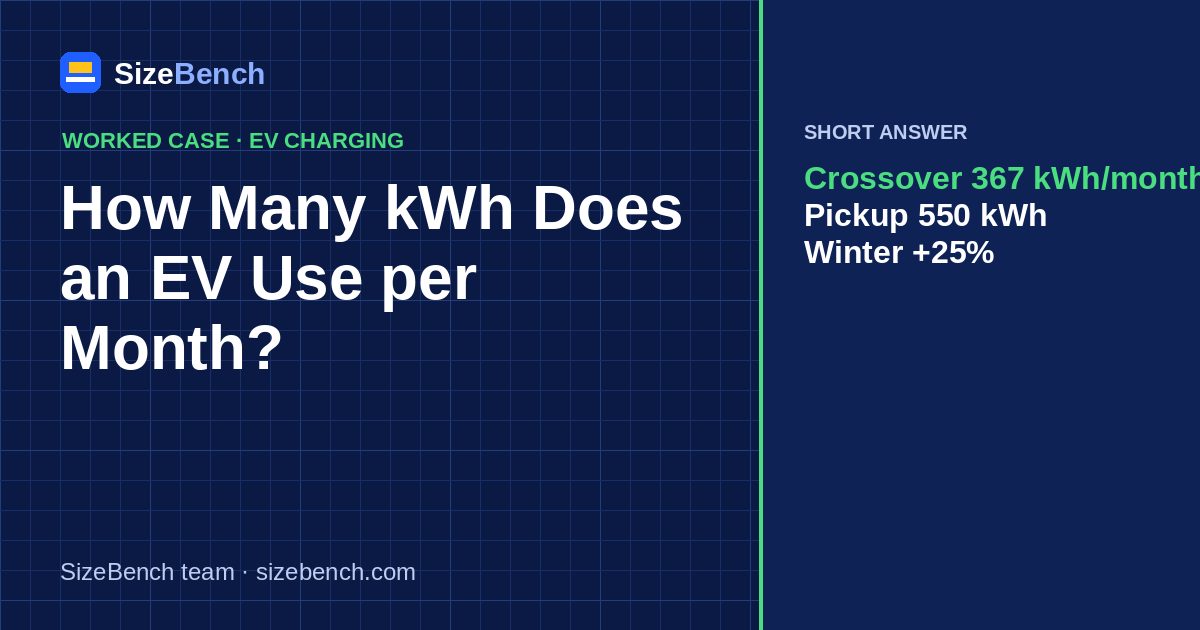
Short answer: about 302 kWh a month for an efficient sedan, 367 kWh for a midsize crossover, 465 kWh for a large SUV and 550 kWh for a pickup. Winter months run about 25% higher. Measured against an average home's roughly 900 kWh a month, the crossover adds about 41%.

1. The formula
kWh per month = miles per month ÷ miles per kWh × 1.10
- Miles per kWh is the car's efficiency. fueleconomy.gov lists it as kWh per 100 miles; divide 100 by that figure to convert. A rating of 30 kWh/100 mi equals 3.33 mi/kWh.
- The 1.10 factor covers charging losses between the wall and the battery. The car's trip computer does not see them, but your electricity meter does.
For the crossover: 1,100 ÷ 3.3 × 1.10 = 367 kWh.
2. Four vehicles, same driving
| Vehicle | Efficiency (assumed) | kWh/100 mi | kWh per month |
|---|---|---|---|
| Efficient sedan | 4.0 mi/kWh | 25 | 302 |
| Midsize crossover | 3.3 mi/kWh | 30 | 367 |
| Large SUV | 2.6 mi/kWh | 38 | 465 |
| Full-size pickup | 2.2 mi/kWh | 45 | 550 |
The efficiencies are typical values for each class, not ratings for specific models. Look up your own car's figure on fueleconomy.gov and the result changes in proportion.
The spread is large. Size and shape decide it: a heavy, boxy pickup pushes much more air and mass than a low sedan, and its monthly use shows it.
3. How mileage moves the number
| Miles per month | Sedan | Crossover | SUV | Pickup |
|---|---|---|---|---|
| 500 | 138 | 167 | 212 | 250 |
| 800 | 220 | 267 | 338 | 400 |
| 1,100 | 302 | 367 | 465 | 550 |
| 1,500 | 413 | 500 | 635 | 750 |
| 2,000 | 550 | 667 | 846 | 1,000 |
All values are kWh per month from the wall. A two-car household simply adds the two lines it drives.
4. Seasons: why January's bill is bigger
Efficiency is not constant through the year. In cold weather an EV heats the cabin and the battery with its own energy, and cold batteries are less efficient. In hot weather the air conditioning adds a smaller penalty. Our assumptions for the crossover:
- Dec–Feb: +25%, so about 458 kWh a month.
- Mar and Nov: +12.5%.
- Jun–Aug: +10% for air conditioning, about 403 kWh.
- Spring and fall: the base figure, 367 kWh.
The year totals about 4,877 kWh, an average of 406 kWh a month. How strong the winter effect is depends heavily on climate, on whether the car has a heat pump, and on how much of the warming is done while still plugged in.

5. Putting it next to the house
The EIA puts the average US household at roughly 900 kWh a month. Adding an EV that drives 1,100 miles:
| Vehicle | EV kWh/month | House + EV | Increase |
|---|---|---|---|
| Sedan | 302 | 1,202 | +34% |
| Crossover | 367 | 1,267 | +41% |
| Large SUV | 465 | 1,365 | +52% |
| Pickup | 550 | 1,450 | +61% |
If your bill shows tiered rates, the EV's kWh land at the top of the tier ladder. That is where time-of-use plans and overnight charging schedules make a difference.
6. Covering it with solar
Using the same method as the solar calculator, at 4.5 sun hours a day and 14% system losses:
kWp = 367 ÷ 30 ÷ (4.5 × 0.86) = 3.16 kWp, or 8 panels of 400 W for the crossover. The pickup needs 4.74 kWp, or 12 panels.
Sun hours vary a lot by location. NREL's PVWatts gives the figure for your address.
7. A two-car household, worked through
Real households rarely have one car and one tidy mileage figure. Take a family with a crossover that does the 1,100-mile commute and errands, and a pickup that only does 600 miles a month of weekend work:
- Crossover: 1,100 ÷ 3.3 × 1.10 = 367 kWh
- Pickup: 600 ÷ 2.2 × 1.10 = 300 kWh
- Together: 667 kWh a month, about 74% on top of an average home.
In January, with the 25% winter penalty on both, that becomes about 833 kWh. Spread over 30 nights, it is 27.8 kWh a night, which one 32 A Level 2 charger delivers in about 3.6 hours. Even two heavy users fit comfortably on one charger if they take turns.
8. What changes the number, and what does not
Several things people expect to matter turn out not to:
- Battery size does not change monthly kWh. A bigger pack holds more, but the car still uses the same energy per mile, plus a little for the extra weight.
- Charging to 80% or 100% does not change monthly kWh either. You simply charge more often or less often.
- Level 1 versus Level 2 changes it only slightly. Slow charging spends a few more hours running the car's electronics, so losses can be a bit higher, especially in the cold.
The things that do matter:
- Speed. Highway driving at 75 mph uses noticeably more energy per mile than suburban driving at 40 mph, because air drag climbs fast with speed.
- Climate control. Resistive cabin heating is the largest single winter load. Cars with a heat pump lose less in the cold.
- Preconditioning while plugged in. Warming the cabin and battery from the grid before you leave still uses kWh, but it comes from the wall with the charger running, and the battery starts the drive warm.
- Tires and load. Winter tires, roof boxes and towing all raise kWh per mile. Towing with a pickup can add a large share to the trips it is used for.
9. Plug-in hybrids: capped by the battery
A plug-in hybrid works differently. Its electric use is capped by how much the small battery holds, because once it is empty the gasoline engine takes over. Assume about 15 kWh usable, charged fully every night, and fully used on the commute:
15 kWh × 1.10 × 30 nights = 495 kWh a month at most, whatever the mileage.
At an assumed 3.0 mi/kWh, that covers about 1,350 electric miles a month. If the household drives less than that on battery, the monthly kWh falls in proportion.
10. Estimating before you buy
A quick checklist to get the number right for a car you have not bought yet:
- [ ] Find the car's kWh/100 mi on fueleconomy.gov, and convert it to mi/kWh
- [ ] Take real monthly miles from service records or the odometer, not a guess
- [ ] Multiply miles ÷ mi/kWh by 1.10
- [ ] Add 25% for winter months if you live where it freezes
- [ ] Note how much will be charged away from home; those kWh never reach your meter
- [ ] Compare the total with last year's bill for the same months
11. Reading your own numbers
- The car's energy screen: shows kWh per mile or miles per kWh, measured at the battery. Multiply its kWh by 1.10 to estimate what the meter sees.
- The charger app: most smart chargers report kWh per session, measured at the wall. This is the closest number to your bill.
- The utility bill: compare the same month year over year, so heating and cooling cancel out.
12. Signs the number is off
- Monthly kWh far above the table: check for preconditioning left on a schedule, or a charging cord on a weak outlet with high losses.
- App and bill disagree by more than a few percent: other new loads in the house, or a billing period that is not a calendar month.
13. Common mistakes
- Using the trip computer's kWh as the bill figure. It leaves out charging losses.
- Taking one winter month as the yearly average.
- Comparing two EVs on battery size. Monthly use depends on efficiency and miles, not on the size of the pack.
FAQ
How many kWh per day does an EV use? At 1,100 miles a month, the crossover uses about 12.2 kWh a day, the pickup 18.3 kWh.
How many kWh for 1,000 miles? About 333 kWh for the crossover, 275 kWh for the sedan.
How long does Level 2 take to put a month back? At 6.9 kW delivered (32 A at 240 V, 90% efficiency), the crossover's 333 kWh at the battery take about 48 hours spread over the month.
Does the EV double my bill? Not for a typical home. The crossover adds about 41% to an average 900 kWh month.
Case summary
| Vehicle | kWh per month | kWh per year (with seasons) |
|---|---|---|
| Sedan | 302 | 4,023 |
| Crossover | 367 | 4,877 |
| Large SUV | 465 | 6,190 |
| Pickup | 550 | 7,315 |
Want it in your own numbers? The EV charging cost calculator takes your miles and your car's efficiency and applies the same 10% loss factor.
Try it with your own numbersEV Charging Cost Calculator (vs Gas)→Sources and references
- U.S. DOE and EPA – fueleconomy.gov official kWh per 100 miles ratings behind the efficiency assumptions
- Federal Highway Administration – Average annual miles per driver typical annual mileage used for the monthly distance
- U.S. Energy Information Administration – electricity use FAQ average household consumption, for comparison
- U.S. Department of Energy – Alternative Fuels Data Center, charging at home home charging basics
- NREL PVWatts Calculator sun hours for the solar sizing step
Standards and data behind our calculators
How we made this guide
Every number in this guide is calculated by the same code as our calculators, from the standards listed above, and the page is tested before publication. The SizeBench team researched, wrote and reviewed it; we use automation and AI tools to help draft, never to produce the figures. Our methodology →
Revision history
- · Published