The case: a cabinet table saw with a 3 hp, 230 V single-phase induction motor. The owner needs three answers: the motor's power in kilowatts, the amps it will draw on the shop circuit, and roughly what a portable generator has to supply.
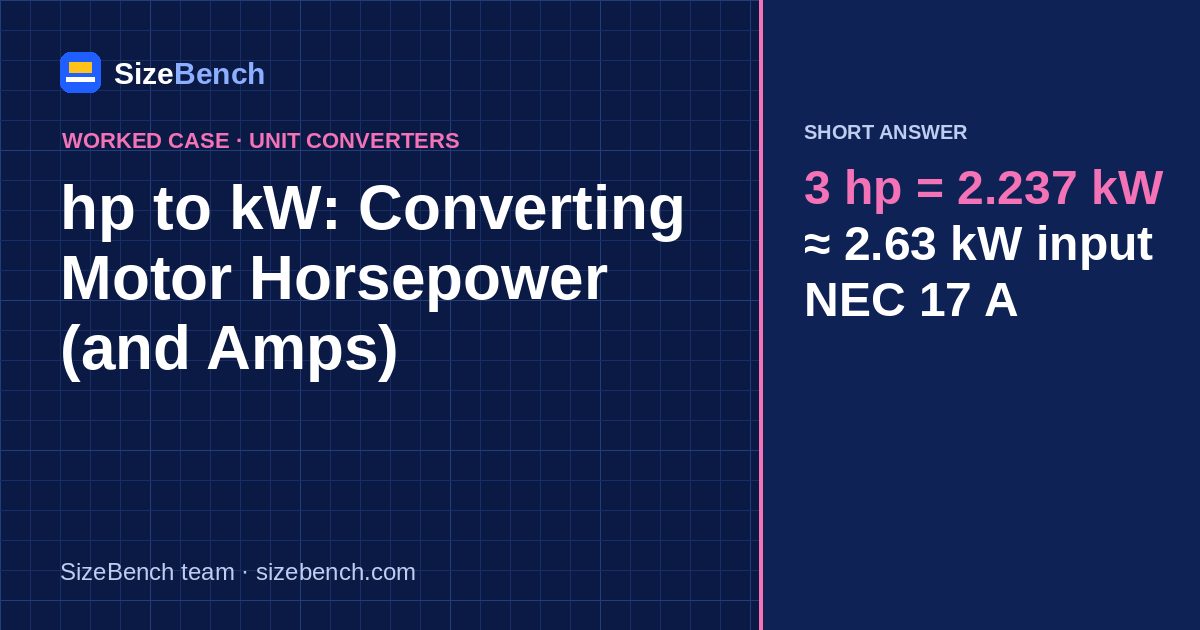
Short answer: 3 mechanical horsepower is 2.237 kW of shaft output. The motor is not 100% efficient, so at an assumed 85% efficiency it draws about 2.63 kW of real power. With a power factor of 0.85, that is 13.5 A at 230 V under full load. For wiring, though, the NEC tells you to use its table value for a 3 hp, 230 V single-phase motor, 17 A, not your own estimate.

1. Which horsepower? Three definitions
"Horsepower" is not one unit. The converter keeps the three that matter apart:
| Unit | Definition | Watts |
|---|---|---|
| Mechanical hp (US, UK) | 550 ft·lbf per second | 745.70 W |
| Electrical hp | Defined as exactly 746 W | 746 W |
| Metric hp (PS, CV, ch) | 75 kgf·m per second | 735.50 W |
US motor nameplates use mechanical horsepower. European equipment often shows kW directly, or PS and CV in older literature. The difference between mechanical and metric hp is about 1.4%: small, but it adds up when converting a 100 hp figure.
3 hp × 745.7 W = 2,237 W = 2.237 kW
The quick mental rule is "multiply hp by three quarters": 3 × 0.75 = 2.25 kW, close enough for a conversation.
2. Horsepower is output; the meter sees input
A motor's horsepower rating is the mechanical power it can deliver continuously at the shaft. Converting energy always loses some as heat in the windings and iron, and in bearing and fan friction. So the electrical input is higher:
Input = output ÷ efficiency = 2.237 ÷ 0.85 = 2.63 kW
Small single-phase motors are often in the 75 to 88% range. Large three-phase premium-efficiency motors reach the low to mid 90s. The nameplate may print the exact figure; if it does, use it.
3. From kW to amps
Induction motors also draw reactive current to magnetize the iron. That current does no work, but the wires still carry it. The power factor (PF) accounts for it:
Amps (single-phase) = input W ÷ (V × PF) = 2,632 ÷ (230 × 0.85) = 13.5 A
For a three-phase motor the formula divides by √3 as well. The same 3 hp on a 230 V three-phase supply, at 88% efficiency and PF 0.85, draws about 7.5 A per line. That is why shops with three-phase power can run bigger machines on smaller wire.
4. The NEC table beats the nameplate for wiring
Here is the step people miss. For general motor applications, the NEC requires conductors and branch-circuit protection to be sized from its own full-load current tables, not from the nameplate and not from a calculation. The table values are deliberately conservative, because they have to cover slow, inefficient and older motors too.
| Motor (single-phase, 230 V) | Shaft kW | Our estimate (85% eff., PF 0.85) | NEC table full-load current |
|---|---|---|---|
| 1 hp | 0.75 | 4.5 A | 8 A |
| 2 hp | 1.49 | 9.0 A | 12 A |
| 3 hp | 2.24 | 13.5 A | 17 A |
| 5 hp | 3.73 | 22.4 A | 28 A |
The conductors then carry at least 125% of the table current: 21.25 A for the 3 hp saw. Overload protection, by contrast, is set from the nameplate current. The breaker or fuse protecting the circuit may be larger than the wire's normal rating so that it rides through the starting surge. These rules interact, so have the final selection checked by an electrician against the current code edition.

5. Conversion table: hp to kW
| hp | kW (mechanical hp) | kW (metric PS) | Input kW at 85% | Amps at 230 V, PF 0.85 |
|---|---|---|---|---|
| 0.5 | 0.373 | 0.368 | 0.44 | 2.2 |
| 1 | 0.746 | 0.735 | 0.88 | 4.5 |
| 1.5 | 1.119 | 1.103 | 1.32 | 6.7 |
| 2 | 1.491 | 1.471 | 1.75 | 9.0 |
| 3 | 2.237 | 2.206 | 2.63 | 13.5 |
| 5 | 3.728 | 3.677 | 4.39 | 22.4 |
| 7.5 | 5.593 | 5.516 | 6.58 | 33.7 |
| 10 | 7.457 | 7.355 | 8.77 | 44.9 |
The amps column is an estimate for understanding loads and generator sizes. For conductor sizing, use the NEC table.
6. Generator sizing for the saw
A generator has to cover both the running input and the starting surge. Running, the saw needs about 2.63 kW, or 3.10 kVA once power factor is included. Across the line, an induction motor commonly draws several times its running current for a second or two at startup. A common planning margin is surge capacity of two to three times the running watts, but the real figure depends on the motor's start design. Check the generator's starting (surge) rating, not just its running rating, and start the largest motor first with nothing else running.
7. Energy: what the saw actually uses
Power is a rate; the electric bill counts energy. Assume the saw cuts for 2 hours on a shop day and averages 60% of full load while it runs, because much of that time is feeding stock, not cutting at full depth. Input power at partial load is roughly 1.58 kW, so a shop day uses about 3.2 kWh. Over 100 shop days a year that is 316 kWh. Motor efficiency drops at light load, so treat the figure as a floor rather than an exact number.
8. The same chain for pumps and compressors
The conversion works the same for any motor. A 1.5 hp pool pump is 1.12 kW of shaft power. At 80% efficiency and PF 0.9 on 230 V it draws about 6.8 A, or twice that on 115 V. For a 0.5 hp well pump on 230 V, the same assumptions give 2.3 A. Small motors tend to be less efficient, so their real input is proportionally higher. When the nameplate lists FLA, believe it over any estimate, including this one.
9. Reading a motor nameplate
- HP and kW. Many modern plates show both, such as "3 HP / 2.2 kW". The kW figure is usually rounded to a standard metric frame size.
- FLA (full-load amps). Measured for that specific motor at rated voltage. Use it for setting overload protection.
- SF (service factor). A 1.15 SF motor can run continuously at 115% of rated hp, with more heat.
- Efficiency and PF. Sometimes listed. Use them in place of the assumptions here.
- Volts. Dual-voltage motors such as "115/230 V" draw half the current on 230 V. Check the wiring diagram for the jumper settings.
10. Signs the motor and circuit are mismatched
- The breaker trips at startup but not while running. The starting surge is too much for the breaker type or rating, or the voltage sags on a long, thin run. Check the wire size and length before you upsize the breaker.
- The motor hums and starts slowly. Low voltage, a failing start capacitor, or a 230 V motor jumpered for 115 V on the wrong supply.
- The motor housing is too hot to touch after a normal cut. It is overloaded, its cooling is blocked by dust, or it is running on low voltage. Current then rises above FLA.
- Lights dim sharply every time the saw starts. The saw shares a circuit with lighting, or the service is marginal. Motors of this size deserve a dedicated circuit.
A clamp meter on one conductor during a full-depth rip tells you more than any calculation. Compare the reading with the nameplate FLA. Sustained readings above FLA mean the motor is overloaded.
11. Shop wiring checklist
- [ ] Motor voltage jumpers match the supply (230 V here)
- [ ] Conductors sized from the NEC table current × 125% (21.25 A)
- [ ] Branch-circuit protection chosen per the motor rules, not the wire chart alone
- [ ] Overload protection set from the nameplate FLA
- [ ] Disconnect within sight of the machine
- [ ] Generator surge rating checked if the saw goes to job sites
12. Common mistakes
- Treating hp as input power. A "3 hp" motor uses more than 2.24 kW from the wall.
- Mixing PS and hp. A 100 PS engine is 73.5 kW, but 100 hp is 74.6 kW.
- Sizing wire from the nameplate FLA. The NEC wants its table value for general motor circuits.
- Believing "peak hp" claims. Shop vacuums and some compressors advertise peak horsepower that the motor cannot deliver continuously. Running amps on the plate tell the truth.
FAQ
How many kW is a 5 hp motor? 3.73 kW of shaft output. At 85% efficiency it draws about 4.39 kW.
How many amps does a 1 hp motor draw at 120 V? At the same assumptions, about 8.6 A. The NEC table for 115 V lists a higher value, so size the circuit from the table.
Is 1 kW more or less than 1 hp? More. 1 kW is 1.341 mechanical hp.
What about a 240 V motor rated in kW only? Divide by 0.7457 to get hp, then work forward as above: a 2.2 kW motor is 2.95 hp.
Why does my clamp meter show less than the estimate? Because the saw is idling, not cutting at full load. The current rises toward FLA only when the blade is working hard.
Case summary
| Item | Result |
|---|---|
| Motor | 3 hp, 230 V, single-phase |
| Shaft output | 2.237 kW |
| Electrical input (85% efficient) | 2.63 kW (3.10 kVA at PF 0.85) |
| Estimated running current | 13.5 A |
| NEC table current for wiring | 17 A, conductors at 21.25 A |
Converting another rating? Use the hp to kW converter for the unit change, then apply your motor's efficiency and power factor to get amps.
Try it with your own numbersPower Converter: hp to kW, PS, BTU/h and Tons→Sources and references
- NIST Special Publication 811 – Guide for the Use of the International System of Units the exact definition of mechanical horsepower (550 ft·lbf/s) and its value in watts
- NFPA 70, National Electrical Code (NEC) the full-load current tables for single-phase motors and the rule to size motor circuits from them rather than from the nameplate, described in words
- National Electrical Manufacturers Association (NEMA) motor nameplate conventions (rated output in hp, service factor, efficiency)
- SizeBench hp to kW power converter the same exact conversion factors (745.7 W, 746 W and 735.5 W)
Standards and data behind our calculators
How we made this guide
Every number in this guide is calculated by the same code as our calculators, from the standards listed above, and the page is tested before publication. The SizeBench team researched, wrote and reviewed it; we use automation and AI tools to help draft, never to produce the figures. Our methodology →
Revision history
- · Published