The case: a 1/2 hp submersible sump pump that draws about 1,000 W running and, we assume, about 2,000 W extra for the fraction of a second it takes to start. It runs on a 12 V battery bank of two 100 Ah lithium (LiFePO4) batteries through an inverter.
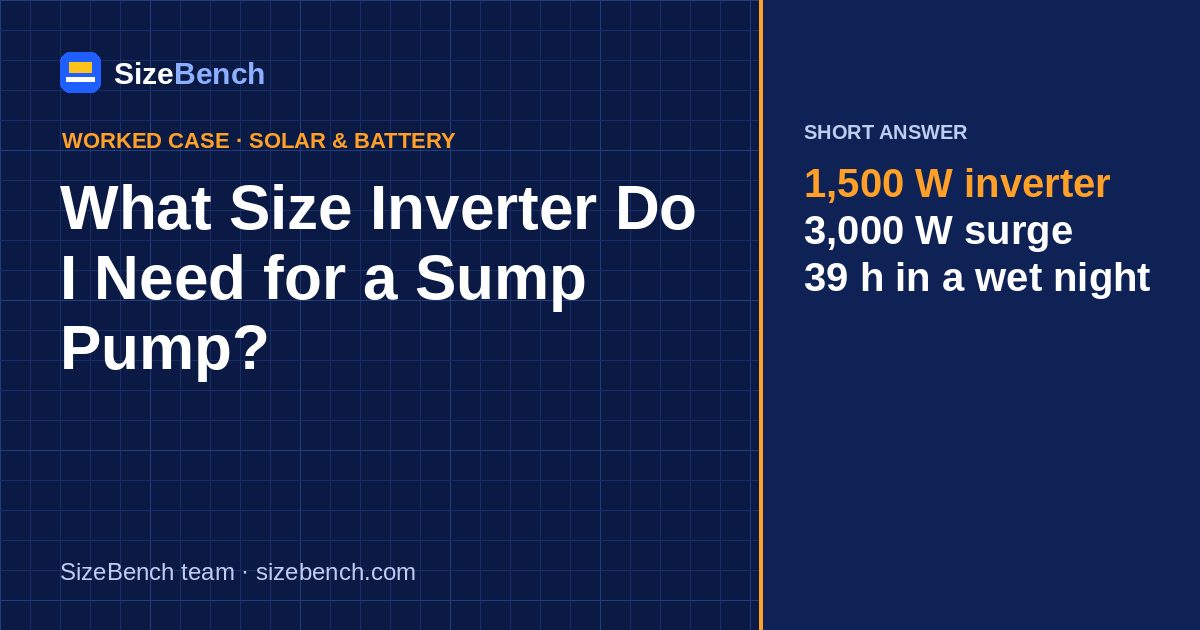
Short answer: a 1,500 W pure sine wave inverter with a surge rating of at least 3,000 W. At 12 V the pump draws about 93 A from the battery, so the DC fuse is 125 A. The battery lasts about 39 hours on a wet night (6 pump cycles an hour) and about 18 hours in a heavy storm (20 cycles an hour).

1. The two numbers an inverter must meet
An inverter has two ratings, and a pump tests both:
- Continuous rating: what it can deliver indefinitely. It must cover the pump's running watts with a margin. We use 25%: 1,000 × 1.25 = 1,250 W.
- Surge rating: what it can deliver for a moment. It must cover the running watts plus the starting extra: 1,000 + 2,000 = 3,000 W.
Most inverters list a surge of about twice their continuous rating. So the continuous rating must also be at least half the surge: 3,000 ÷ 2 = 1,500 W. The larger of the two requirements is 1,500 W, and the next common size is 1,500 W.
That is exactly the calculation the inverter calculator runs. If the inverter you are looking at lists a surge of less than twice its continuous rating, check the surge figure directly against 3,000 W.
2. Where the pump's numbers come from
The pump's nameplate gives amps at 115 or 120 V. Watts are roughly volts × amps. A 1/2 hp pump labeled around 8 to 9 A runs close to 1,000 W. The starting surge is not on the nameplate. Induction motors typically draw a brief inrush of several times their running current, so we assume the peak is three times the running watts.
| Pump | Running (assumed) | Start extra (assumed) | Peak | Inverter |
|---|---|---|---|---|
| 1/3 hp | 700 W | 1,400 W | 2,100 W | 1,500 W |
| 1/2 hp | 1,000 W | 2,000 W | 3,000 W | 1,500 W |
| 3/4 hp | 1,300 W | 2,600 W | 3,900 W | 2,000 W |
| 1 hp | 1,600 W | 3,200 W | 4,800 W | 2,500 W |
If you can measure, a clamp meter with an inrush function shows the real starting current. It is the most useful ten minutes you can spend before buying.
3. Pure sine wave, not modified
A motor on a modified sine wave inverter runs hotter, hums, and may not start reliably. The pump's float switch and any controller electronics also prefer a clean waveform. For a pump, a pure sine wave inverter is the only sensible choice.
Inverters built around a heavy transformer (often called low-frequency inverters) tend to handle motor starts better than lightweight high-frequency units with the same continuous rating, because they can sustain a surge for longer. If the pump sits close to the limit, that matters more than an extra 500 W on paper.
4. DC current: the side people underestimate
At 12 V, every watt comes out of the battery as a large current:
| Battery voltage | Running current | DC fuse (125%) | Current during start |
|---|---|---|---|
| 12 V | 93 A | 125 A | about 278 A |
| 24 V | 46 A | 60 A | about 139 A |
The running current is 1,000 W ÷ (12 V × 90% inverter efficiency). The fuse or breaker goes as close to the battery as possible and protects the cable, which is why the NEC requires overcurrent protection on battery conductors. The cable must be sized for the fuse and kept short; the inverter manual lists the minimum gauge for each length.
For a 1/2 hp pump, 12 V works with short, heavy cables. For a 3/4 hp or 1 hp pump, a 24 V bank halves the current and makes the wiring far easier.

5. Runtime: it depends on the weather, not the pump
A sump pump does not run continuously. It runs for a short cycle each time the pit fills. We assume each cycle lasts 15 seconds, and the inverter draws 25 W just being switched on. The average load is:
Average W = 25 + 1,000 × cycles per hour × 15 ÷ 3,600
The battery runtime formula is hours = Ah × V × depth of discharge × inverter efficiency ÷ average W. With 200 Ah at 12 V, 90% usable and 90% efficiency, the bank delivers 1,944 Wh.
| Conditions | Cycles/hour | Average load | Lithium, 90% usable | Lead-acid, 50% usable |
|---|---|---|---|---|
| Dry spell | 1 | 29 W | 67 h | 37 h |
| Wet night | 6 | 50 W | 39 h | 22 h |
| Heavy storm | 20 | 108 W | 18 h | 10 h |
| Flood, near constant | 40 | 192 W | 10 h | 6 h |
Two things stand out. In dry weather, the inverter's idle draw is the main load: an inverter with a 5 W standby mode would stretch the dry-spell figure from 67 to about 212 hours. And in a real flood, even the lithium bank lasts about 10 hours, one night.
6. Sizing the battery for a target
Turn the formula around to size the bank for a goal. To ride out 24 hours of heavy storm (average 108 W):
Ah = 108 W × 24 h ÷ (12 V × 0.9 × 0.9) = 267 Ah of lithium at 12 V, so three 100 Ah batteries. With lead-acid at 50% usable it would take 481 Ah, a heavy and bulky bank for a basement shelf.
7. Recharging between outages
The battery has to be full when the next storm hits. A battery charger or an inverter-charger keeps it topped up from the grid. During a long outage, a small generator or a solar panel can recharge it. Without either, the figures above are a one-shot reserve.
8. Installation checklist
- [ ] Pump running amps read from the nameplate, starting current measured or assumed at 3×
- [ ] Pure sine wave inverter, continuous ≥ 1,500 W, surge ≥ 3,000 W
- [ ] DC fuse or breaker of 125 A at the battery (12 V), cables per the inverter manual
- [ ] Battery and inverter mounted above flood level, never on the basement floor
- [ ] Automatic transfer, so the pump switches to the inverter without anyone in the house
- [ ] Charger keeps the battery full; a high-water alarm on the pit
9. Signs of a problem
- Inverter beeps and shuts off when the pump starts: the surge is too high. Bigger inverter, a low-frequency unit, or a 24 V system.
- Pump hums but does not turn: voltage sagging during start; cables too thin or too long.
- Runtime far below the table: cycles are longer than assumed, or the battery is aged.
10. Common mistakes
- Sizing on running watts alone. A 1,250 W inverter matches the running load with margin but cannot start the pump.
- Mounting the backup on the floor of the room it is supposed to keep dry.
- Forgetting idle draw. At 25 W it uses 0.6 kWh a day even when the pump never runs.
FAQ
Will a 1,000 W inverter run a 1/2 hp sump pump? Not reliably. The pump peaks around 3,000 W, and a 1,000 W unit usually surges to about 2,000 W.
How long will a 100 Ah 12 V battery run a sump pump? Half of this bank: about 19 hours on a wet night and 9 hours in a heavy storm, with lithium.
Is 24 V better? For a pump up to 1/2 hp, 12 V is fine. Above that, 24 V halves the current to 60 A for a 1,300 W pump and makes the cabling manageable.
Can the same inverter also run a freezer? A chest freezer adds about 150 W running and its own start surge. If both motors start together, the peak can exceed 3,000 W, so step up to the next size, 2,000 W or more, and expect the runtime figures above to shrink.
Why not just a DC backup pump? Dedicated 12 V backup pumps skip the inverter and its idle draw, so they stretch a battery further. The trade-off is lower pumping capacity than the main pump, which matters in a heavy storm.
Can I use a UPS? Only one rated for motor loads with enough surge capacity; most computer UPS units are not.
Case summary
| Item | Result |
|---|---|
| Pump | 1/2 hp, 1,000 W running, 3,000 W peak |
| Inverter | 1,500 W pure sine, surge ≥ 3,000 W |
| DC current and fuse at 12 V | 93 A, 125 A fuse |
| Battery | 200 Ah lithium at 12 V, 1,944 Wh delivered |
| Runtime | 67 h dry, 39 h wet, 18 h storm |
Different pump or battery? Put the running and surge watts in the inverter size calculator; it applies the same rules.
Try it with your own numbersInverter Size Calculator→Sources and references
- U.S. Department of Energy – Estimating appliance and home electronic energy use converting nameplate amps to watts and duty cycle to energy
- Ready.gov – Power outages outage preparation and keeping critical equipment running
- U.S. Department of Energy – Energy Saver: Off-grid or stand-alone renewable energy systems battery and inverter basics for stand-alone systems
- NFPA 70, National Electrical Code (NEC) overcurrent protection for battery conductors, described in words
- SizeBench inverter size calculator the same continuous, surge and DC fuse method
Standards and data behind our calculators
How we made this guide
Every number in this guide is calculated by the same code as our calculators, from the standards listed above, and the page is tested before publication. The SizeBench team researched, wrote and reviewed it; we use automation and AI tools to help draft, never to produce the figures. Our methodology →
Revision history
- · Published