The case: a midsize EV with a 75 kWh battery that goes about 3.5 miles per kWh, plugged into a standard 120 V garage outlet with the cord that came with the car. The cord draws 12 A. The driver commutes 30 miles a day.
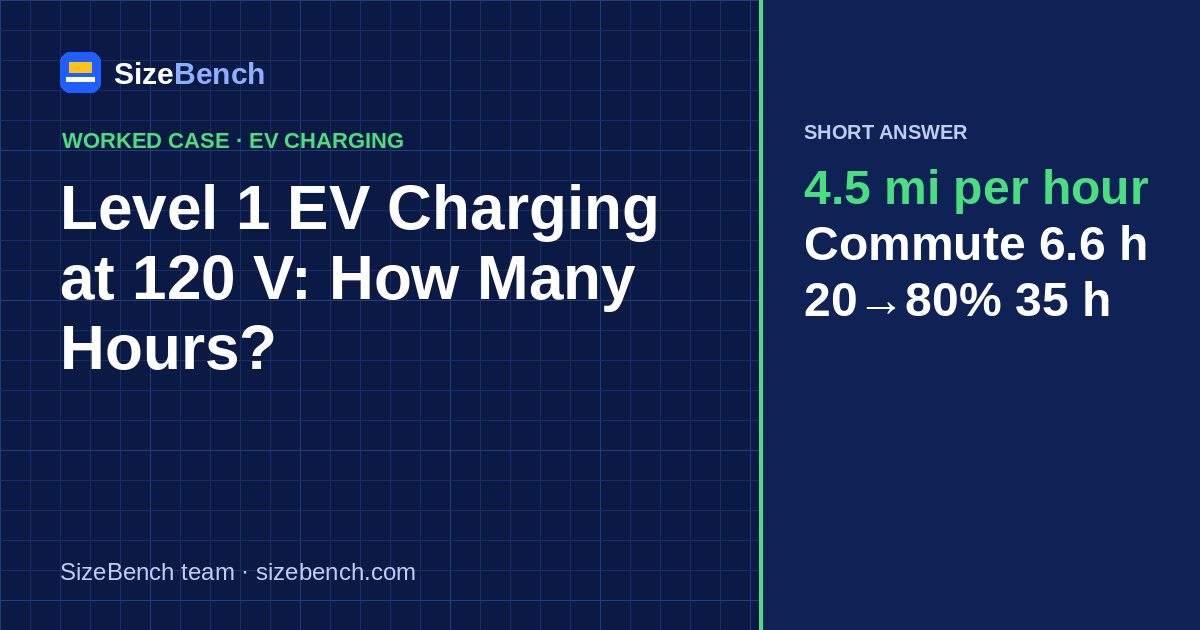
Short answer: Level 1 adds about 4.5 miles per hour of charging. The daily 30-mile commute takes 6.6 hours to put back. A 20 to 80% top-up takes 35 hours, and a completely empty battery takes 58 hours to fill. On a 20 A circuit at 16 A, those times drop by a quarter.

1. The formula
Charging time is energy divided by the power that actually reaches the battery:
Hours = kWh needed ÷ (charger kW × efficiency)
- Charger power: amps × volts. At 12 A and 120 V that is 1.44 kW.
- Efficiency: we use 90%, the same value the charging calculator uses for AC charging. Part of the remaining 10% is lost in the car's onboard charger, part in wiring and battery electronics.
- Power reaching the battery: 1.44 × 0.90 = 1.30 kW.
Turn that into miles: 1.30 kW × 3.5 mi/kWh = 4.5 miles of range per hour plugged in.
2. Why 12 A and not 15 A
A standard outlet sits on a 15 A or 20 A circuit. The NEC treats EV charging as a continuous load and limits it to 80% of the circuit rating:
| Circuit | Outlet | Continuous limit | Charger power | To battery |
|---|---|---|---|---|
| 15 A, 120 V | NEMA 5-15 | 12 A | 1.44 kW | 1.30 kW |
| 20 A, 120 V | NEMA 5-20 | 16 A | 1.92 kW | 1.73 kW |
Most portable cords default to 12 A because that is safe on any outlet. Some can be switched to 16 A, but only on a 20 A circuit with a 5-20 receptacle (the one with a T-shaped slot). Setting 16 A on a 15 A circuit will trip the breaker or, worse, overheat the outlet.
3. Hours for the jobs that matter
| Job | Energy to battery | 12 A | 16 A |
|---|---|---|---|
| 30-mile commute | 8.6 kWh | 6.6 h | 5.0 h |
| 60-mile day | 17.1 kWh | 13.2 h | 9.9 h |
| 20 → 80% of 75 kWh | 45 kWh | 34.7 h | 26.0 h |
| 0 → 100% of 75 kWh | 75 kWh | 57.9 h | 43.4 h |
The commute fits easily into one night. A road-trip top-up does not: 35 hours is a day and a half. That is the honest trade-off of Level 1. It keeps up with daily driving; it does not recover from a long trip quickly.
4. Think in miles per night
The better question is how many miles a night refills. That depends on how long the car sits plugged in:
| Hours plugged in | 12 A | 16 A | 12 A in cold weather |
|---|---|---|---|
| 8 h | 36 mi | 48 mi | 32 mi |
| 10 h | 45 mi | 60 mi | 40 mi |
| 12 h | 54 mi | 73 mi | 48 mi |
| 14 h | 64 mi | 85 mi | 56 mi |
The cold-weather column assumes only 80% reaches the battery, because the car spends some of the trickle keeping the pack warm. In real freezing weather the car also uses more energy per mile, so the true winter figure is lower again.
5. Who can live on Level 1
Level 1 is enough when the daily miles stay under what one night refills. With a 10-hour window at 12 A that is about 45 miles a day. It also works for plug-in hybrids, whose small batteries fill completely overnight.
It gets tight for:
- Long commutes, roughly over 45 miles a day, with no workplace charging.
- Large trucks and SUVs, which use more kWh per mile, so the same hours add fewer miles.
- Cold climates, where pre-heating and battery conditioning use part of the trickle.
- Households with two EVs sharing one outlet.
| Pack size | 20 → 80% at 12 A | 20 → 80% at 16 A |
|---|---|---|
| Compact, 60 kWh | 28 h | 21 h |
| Midsize, 75 kWh | 35 h | 26 h |
| Long-range, 100 kWh | 46 h | 35 h |
| Pickup, 130 kWh | 60 h | 45 h |

6. A week on Level 1: does it keep up?
Daily averages hide the weekend. Take a realistic week for this driver: five commuting days of 30 miles, a Saturday with 80 miles of errands and a visit, and a quiet Sunday of 10 miles. The car is plugged in 11 hours each night at 12 A, which refills about 50 miles per night.
| Day | Miles driven | Miles refilled overnight | Running balance |
|---|---|---|---|
| Mon–Fri (each) | 30 | 50 | +20 per day, capped at the car's charge limit |
| Saturday | 80 | 50 | −30 |
| Sunday | 10 | 50 | +40 |
| Week | 240 | 349 | +109 |
Over the week, Level 1 refills more than the driver uses. Saturday's deficit is made up by Sunday night. The battery acts as a buffer, which is the point: you do not need to refill each day's miles that same night, only the week's miles across the week.
7. When to upgrade to Level 2
Level 1 stops being comfortable when the weekly balance turns negative, or when you regularly need the car full on short notice. Two simple tests:
- Weekly miles above about 318 (ten hours a night, seven nights at 12 A).
- Frequent long trips where coming home with 20% and leaving with 80% the next morning matters. That needs 45 kWh in about 10 hours, or 5.0 kW at the wall, which is Level 2 territory.
A 240 V circuit at 32 A delivers 6.9 kW to the battery, about 5.3 times Level 1.
8. The outlet and circuit
A Level 1 cord pulls its full current for hours. That is unusual for a household outlet, which is why the details matter:
- Dedicated circuit if possible. If a freezer or a shop vac shares the circuit, the total can trip the breaker in the middle of the night.
- Check the outlet's condition. Worn spring contacts get warm under long loads. A warm plug or a discolored faceplate means replace the receptacle now.
- No extension cords. Charger makers prohibit them, and a household extension cord is not built for 12 A around the clock.
- For a new 20 A circuit at 50 ft, 12 AWG copper keeps the drop at 2.57% at 16 A.
9. Reading the cord's label
- Input: 120 V, and the current setting (12 A, sometimes switchable).
- Plug type: NEMA 5-15 for any outlet; a 5-20 plug fits only a 20 A receptacle.
- Listing mark from a recognized testing laboratory.
- Interchangeable plug heads, on some cords, for 240 V use later.
10. Signs of a problem
- Plug or outlet warm to the touch: a contact problem. Stop using that outlet.
- Charging stops overnight: shared circuit tripping, or a GFCI outlet reacting to the cord.
- The car adds far fewer miles than the table: cold weather, or a cord that dropped to a lower current setting.
11. Common mistakes
- Judging Level 1 by "hours to full". Nobody drives from empty to full every day.
- Setting 16 A on a 15 A circuit.
- Using a garage outlet shared with a freezer.
- Leaving the car unplugged on short-drive days. With Level 1, every hour plugged in counts.
FAQ
How many miles does Level 1 add overnight? About 45 miles in 10 hours at 12 A, or 60 miles at 16 A.
How long for a full charge? From empty to full on a 75 kWh battery, about 58 hours at 12 A.
Is a 20 A circuit worth it? It cuts a 20 to 80% charge from 35 to 26 hours. If you are running a new circuit anyway, a 240 V Level 2 circuit gains far more.
What about a plug-in hybrid? A plug-in hybrid with about 15 kWh of usable battery fills from empty in roughly 11.6 hours at 12 A, so one night always covers it. For most plug-in hybrids, Level 1 is all the charging they will ever need.
Can I charge from 10 p.m. to 6 a.m. only, for off-peak rates? Eight hours at 12 A adds about 36 miles. That covers the 30-mile commute with room to spare, but not a 60-mile day.
Does Level 1 waste more energy? The car's electronics run for the whole charging session, so fixed losses weigh more on a slow charge, especially in cold weather. That is why our cold column uses 80%.
Case summary
| Item | 12 A (15 A circuit) | 16 A (20 A circuit) |
|---|---|---|
| Power to battery | 1.30 kW | 1.73 kW |
| Miles per hour | 4.5 | 6.0 |
| 30-mile commute | 6.6 h | 5.0 h |
| 20 → 80% of 75 kWh | 35 h | 26 h |
| Empty to full | 58 h | 43 h |
Different battery or a different start and target? Try it in the EV charging calculator with the Level 1 charger selected.
Try it with your own numbersEV Charging Time Calculator→Sources and references
- U.S. Department of Energy – Alternative Fuels Data Center, charging at home what Level 1 charging is and when it is enough
- U.S. DOE and EPA – fueleconomy.gov official kWh per 100 miles ratings behind the miles-per-kWh assumption
- NFPA 70, National Electrical Code (NEC) continuous-load rule and 15 A / 20 A branch circuits, described in words
- SizeBench EV charging time calculator the same time formula with a 90% AC charging efficiency
Standards and data behind our calculators
How we made this guide
Every number in this guide is calculated by the same code as our calculators, from the standards listed above, and the page is tested before publication. The SizeBench team researched, wrote and reviewed it; we use automation and AI tools to help draft, never to produce the figures. Our methodology →
Revision history
- · Published