The case: a 40 A Level 2 charger, a garage wall 50 ft from the main panel, copper wire, 240 V. Option A is a NEMA 14-50 receptacle with a plug-in charger. Option B is the same charger hardwired.
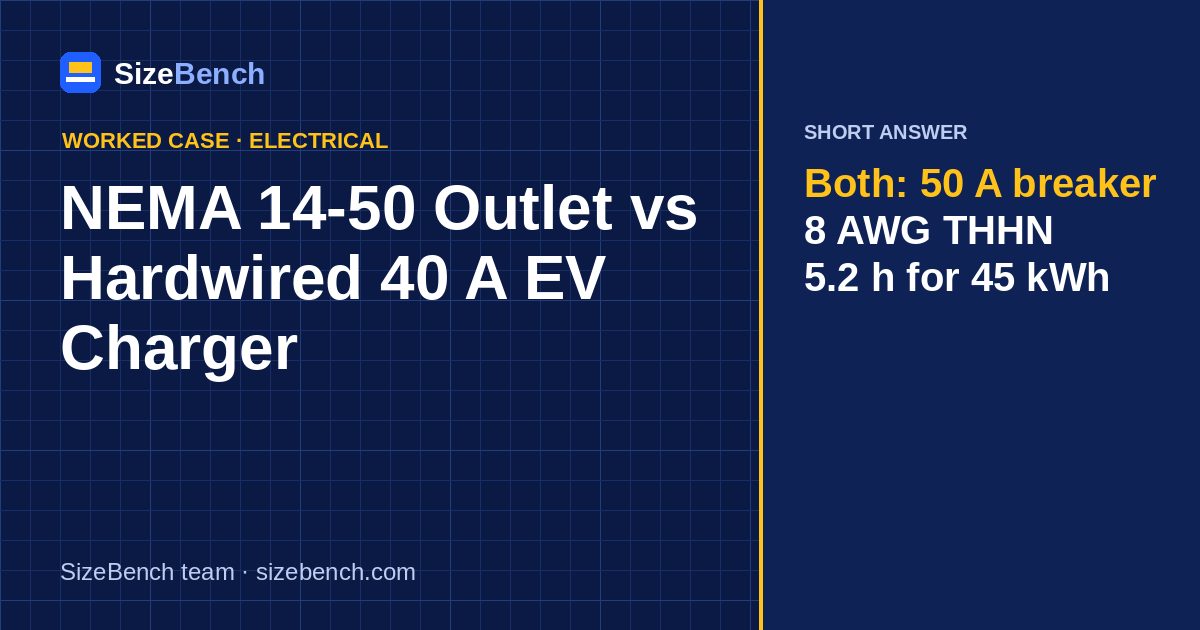
Short answer: both need a 50 A two-pole breaker and 8 AWG copper THHN in conduit (or 6 AWG NM-B cable). Both deliver 9.6 kW and add a 45 kWh charge in about 5.2 hours. Hardwired wins on reliability and upgrade room (up to 48 A on a 60 A circuit). The receptacle wins on flexibility.

1. Why both options land on a 50 A circuit
The NEC treats EV charging as a continuous load: it can run three hours or more at full current. Continuous loads are sized at 125% of the current:
40 A × 1.25 = 50 A, so the breaker is 50 A.
For the receptacle option, the logic runs the other way: a 14-50 is a 50 A device, and a plug-in charger on it is limited to 80% of that, which is 40 A. Either way the circuit is the same, and so is the charging speed. The plug is not the bottleneck at 40 A. It becomes one only when you want more.
2. Wire size: ampacity first, then distance
The wire has to carry the 50 A breaker rating at its temperature column, and keep voltage drop low:
| Wire | Temperature rating used | Ampacity | OK for 50 A? |
|---|---|---|---|
| 8 AWG THHN in conduit | 75 °C | 50 A | Yes |
| 8 AWG NM-B cable | 60 °C | 40 A | No |
| 6 AWG NM-B cable | 60 °C | 55 A | Yes |
At 50 ft the 8 AWG run drops only 1.27% at 40 A, well under a 3% target. Distance starts to matter on long runs: at 100 ft the answer is still 8 AWG (2.55%), and at 150 ft it moves to 6 AWG (2.46%).
One detail for the receptacle option: a 14-50 has a neutral terminal, so the run needs four conductors (two hots, neutral, ground) even though the charger never uses the neutral. A hardwired charger only needs two hots and a ground.
3. GFCI: the rule that changes the receptacle math
Recent NEC editions require GFCI protection for 240 V receptacles in garages and outdoors, and specifically for receptacles installed to charge an EV. In practice, a 14-50 for a car means a 50 A two-pole GFCI breaker.
A hardwired charger is treated differently. Listed EV chargers already contain their own personnel-protection system, so the circuit feeding a hardwired unit uses a standard two-pole breaker.
Two GFCI devices in series (the breaker and the charger's internal protection) occasionally disagree, and some owners see trips that seem to have no cause. If you go with a receptacle, check that the charger's manual allows a GFCI-protected receptacle, and keep the breaker's documentation handy in case it needs replacing.
4. Charging speed: equal at 40 A, different at the next step
| Setup | Circuit | Power | 20 → 80% of 75 kWh | Miles added per hour |
|---|---|---|---|---|
| Plug-in on 14-50, 40 A | 50 A | 9.6 kW | 5.2 h | 30 mi |
| Hardwired, 40 A | 50 A | 9.6 kW | 5.2 h | 30 mi |
| Hardwired, 48 A | 60 A | 11.5 kW | 4.3 h | 36 mi |
| Hardwired, 32 A | 40 A | 7.7 kW | 6.5 h | 24 mi |
Assumptions: 90% of grid energy reaches the battery, and the car goes 3.5 miles per kWh (check yours on fueleconomy.gov). The car's own onboard charger also has a ceiling, printed in the owner's manual. If it tops out at 32 A, a 48 A circuit buys nothing.
A daily 40-mile commute uses about 12.6 kWh from the wall, which any of these setups replaces in about 79 to 98 minutes. For most drivers the speed difference is academic.

5. Where the receptacle can let you down
The weak point of the plug-in setup is not the circuit but the contact between plug and receptacle. A charger pulls 40 A for hours, night after night. A standard-grade receptacle with loose spring contacts, or terminal screws left under-torqued, slowly heats up. Discolored faceplates and melted plugs on EV receptacles are a known failure pattern.
How to avoid it:
- Use an industrial- or heavy-duty-grade 14-50, not the cheapest one on the shelf.
- Torque the terminal screws to the value printed on the device, with a torque screwdriver.
- Avoid unplugging daily. Receptacles are rated for a limited number of insertion cycles.
- Never use an adapter or extension cord between the charger and the receptacle.
A hardwired charger removes this contact point entirely, which is the main reason many electricians prefer it.
6. Where the receptacle wins
- Portability: the charger moves with you when you move house, or goes into the trunk for trips.
- Easy replacement: a failed charger can be swapped without an electrician.
- Dual use: the same 14-50 can feed a 50 A RV or a welder, provided whatever you plug in respects the 40 A continuous limit.
7. Panel capacity and a second EV
Whatever the connection, the panel has to carry the new load. A 40 A charger adds 9.6 kW of continuous demand, and the NEC counts it at full value in the dwelling load calculation. On an older 100 A service that already feeds an electric range and a dryer, this is often the real constraint, not the wire.
Two answers exist, and both favor the hardwired option:
- Lower the charger setting. At 32 A on a 40 A breaker, the added demand drops to 7.7 kW.
- Use load management. Many hardwired chargers accept a current sensor on the service conductors and throttle down when the house is busy. NEC rules allow the managed value to be used in the load calculation when the system is listed for it.
For a household planning a second EV, two hardwired units that share one circuit and split the current between them are often simpler than two separate 50 A circuits. A pair of 14-50 receptacles cannot coordinate with each other.
8. How to read the charger's label
- Maximum output current: 40 A for a plug-in on a 14-50, up to 48 A when hardwired.
- Required circuit breaker: the manual lists it for each current setting. Use it.
- Current setting (DIP switch or app): set it to match the circuit. A charger set to 48 A on a 50 A circuit is a code violation and a fire risk.
- Listing mark from a recognized testing laboratory.
- Enclosure rating if the charger is outside the garage.
9. Installation checklist
- [ ] Dedicated 50 A two-pole circuit (GFCI breaker for the receptacle option)
- [ ] 8 AWG THHN in conduit or 6 AWG NM-B; four wires for a 14-50, three for hardwired
- [ ] Panel load calculation confirms capacity for another 9.6 kW
- [ ] Heavy-duty receptacle, terminals torqued to spec
- [ ] Charger current setting matches the breaker
- [ ] Permit pulled and inspection passed
10. Common mistakes
- Running 8 AWG NM-B. At the 60 °C column it is rated 40 A, below the 50 A breaker.
- Installing a 14-50 without GFCI protection where the current code requires it.
- Raising the charger to 48 A on the existing 50 A circuit after a later upgrade.
- Buying the receptacle option for a charger you will never move. Then the receptacle only adds a contact point and a GFCI breaker.
FAQ
Is a 14-50 slower than hardwired? Not at 40 A: both deliver 9.6 kW. Hardwired is faster only at 48 A: 4.3 h versus 5.2 h for the same 45 kWh.
Can I pull new wire once and decide later? Yes. Size it for 48 A: at 50 ft that is 6 AWG on a 60 A breaker, and run four conductors. Then you can start with a 14-50 on a 50 A breaker and switch to a 48 A hardwired unit by changing the breaker.
What if I only have room for a 40 A breaker? Then the charger is set to 32 A: 7.7 kW, about 6.5 h for 45 kWh, still more than enough for most daily driving.
Does a 14-50 need a neutral? The receptacle does (four wires); the charger does not use it.
Case summary
| Item | 14-50 receptacle | Hardwired |
|---|---|---|
| Charger current | 40 A max | 40 A (48 A on a 60 A circuit) |
| Breaker | 50 A two-pole GFCI | 50 A two-pole |
| Wire at 50 ft | 8 AWG THHN, 4 wires | 8 AWG THHN, 3 wires |
| Voltage drop | 1.27% | 1.27% |
| 45 kWh charge | 5.2 h | 5.2 h |
| Weak point | plug contact, GFCI trips | fixed in place |
Different distance or current? Enter it in the wire size calculator with "continuous" checked; it applies the same 125% rule and voltage-drop check.
Try it with your own numbersWire Size Calculator→Sources and references
- NFPA 70, National Electrical Code (NEC) continuous-load rule for EV charging, GFCI rules for receptacles, described in words
- U.S. Department of Energy – Alternative Fuels Data Center, charging at home Level 2 home charging basics
- U.S. DOE and EPA – fueleconomy.gov official efficiency ratings used for miles per kWh
- NEMA, Ground-Fault Personnel Protection how GFCI protection works
- SizeBench wire size calculator same ampacity and voltage-drop method
Standards and data behind our calculators
How we made this guide
Every number in this guide is calculated by the same code as our calculators, from the standards listed above, and the page is tested before publication. The SizeBench team researched, wrote and reviewed it; we use automation and AI tools to help draft, never to produce the figures. Our methodology →
Revision history
- · Published