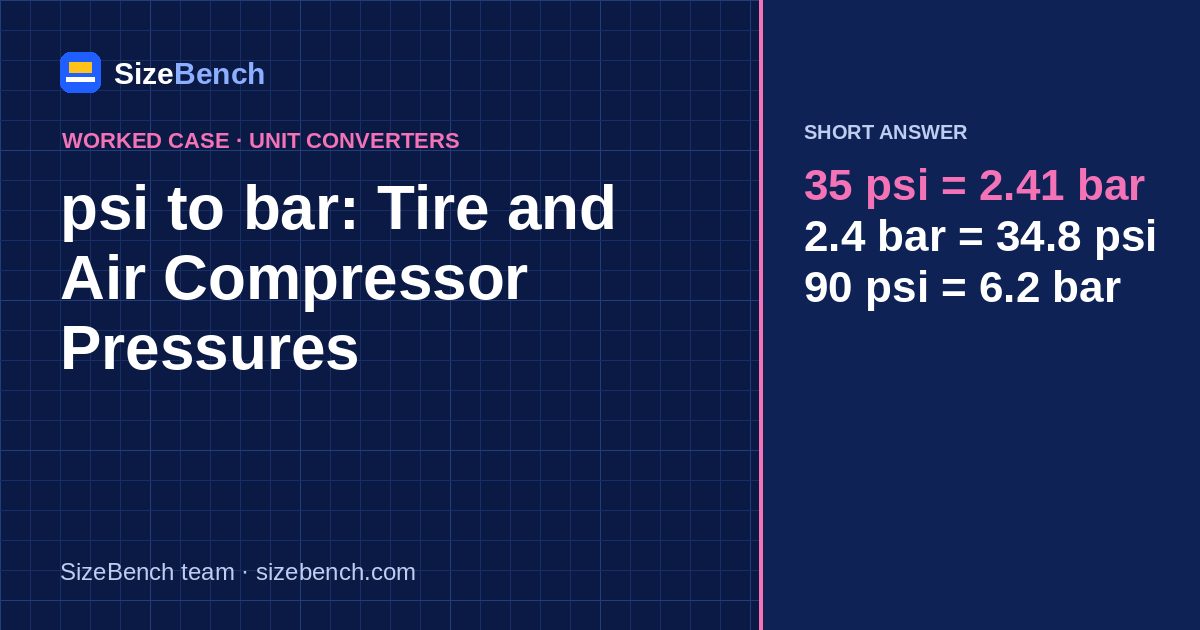
The case: the US sedan's door placard says 35 psi cold. The imported wagon's placard says 2.4 bar. The garage compressor shuts off at 150 psi, and the impact wrench wants 90 psi at the tool. In winter, the first cold morning turns on the low-pressure light.
Short answer: 1 bar is 14.5038 psi, so 35 psi is 2.41 bar (241 kPa) and 2.4 bar is 34.8 psi. The compressor's 150 psi is 10.34 bar, and the tool's 90 psi is 6.21 bar. The light came on because a 35 psi tire set at 70 °F reads about 30.3 psi at 20 °F. That is physics, not a leak.

1. The exact factors
Both units are defined exactly:
- 1 bar = 100,000 Pa (100 kPa), by definition.
- 1 psi is one pound-force on one square inch: 0.45359237 kg × 9.80665 m/s² ÷ (0.0254 m)² = 6,894.757 Pa.
So 1 bar = 14.5038 psi and 1 psi = 0.06895 bar. For mental math, "divide psi by 14.5" is accurate to better than 0.1%. Standard atmospheric pressure is 14.70 psi, or 1.013 bar. That is why 1 bar and "one atmosphere" are often treated as the same, although they differ by about 1.3%.
2. Tire pressures: psi, bar, kPa
Placards in North America give psi, often with kPa beside it. European and Asian vehicles more often give bar. Many station air pumps can display either.
| psi | bar | kPa |
|---|---|---|
| 30 | 2.07 | 207 |
| 32 | 2.21 | 221 |
| 35 | 2.41 | 241 |
| 38 | 2.62 | 262 |
| 41 | 2.83 | 283 |
| 44 | 3.03 | 303 |
The reverse case: the wagon's 2.4 bar is 34.81 psi. Most digital gauges read in half-psi steps, so set 35 psi. Do not round down to 34. Rounding up by half a pound is safer than running soft.
3. Gauge pressure and absolute pressure
Tire and compressor gauges read gauge pressure: how far above the surrounding air the pressure is. A flat tire reads zero even though the air inside is at atmospheric pressure. Engineers write psig and psia, or bar(g) and bar(a), to keep the two apart:
Absolute = gauge + atmospheric = 35 + 14.7 = 49.7 psia
You need absolute pressure whenever you apply the gas laws, as in the next section. Converters like ours convert units, not reference points. 35 psig becomes 2.41 bar(g), never "bar absolute".
4. Why tires lose pressure in the cold
Air in a sealed tire follows the gas law: absolute pressure is proportional to absolute temperature. Set to 35 psi in a 70 °F garage, the same tire on a 20 °F morning reads:
(49.70 psia × (20 + 459.67) ÷ (70 + 459.67)) − 14.70 = 30.3 psi
That is a drop of about 4.7 psi for 50 °F, close to the old rule of one psi per 10 °F.
The placard pressure is a cold pressure. Check it before driving, after the car has sat for a few hours, and refill outdoors in winter. A tire filled to 35 psi in a heated garage loses that pressure as soon as it reaches the cold.

5. Air compressors: tank, cut-out and tool
A compressor spec sheet usually lists three pressures:
- Maximum or cut-out pressure. The switch stops the pump here (150 psi in this case).
- Cut-in pressure. The pump restarts, often 20 to 30 psi below cut-out.
- Tool operating pressure. Set at the regulator, usually 90 psi for impact wrenches and nailers.
| Use | psi | bar | kPa |
|---|---|---|---|
| Air for cleaning (OSHA limit, below) | 30 | 2.07 | 207 |
| Typical air tool | 90 | 6.21 | 621 |
| Spray gun inlet, some tools | 100 | 6.89 | 689 |
| Small pancake compressor cut-out | 125 | 8.62 | 862 |
| Two-stage cut-in (typical) | 145 | 10.00 | 1,000 |
| Garage compressor cut-out (this case) | 150 | 10.34 | 1,034 |
| Two-stage cut-out (typical) | 175 | 12.07 | 1,207 |
European tools are often labeled 6.2 bar, the same thing as 90 psi (89.9 psi). A tool marked "max 6.3 bar" should not see more than 91 psi. Never feed a tool straight from the tank.
6. Altitude and gauges
Because gauges read relative to the surrounding air, a sealed container reads higher where the air is thinner. At 5,000 ft, standard atmospheric pressure is about 12.2 psi instead of 14.7. A tire filled to 35 psi at sea level reads roughly 37.5 psi at that elevation, until it is adjusted. Set tires to the placard value where you drive.
7. Bikes, trucks and spares
The same conversion applies to every tire, but the numbers spread widely. The values below are typical examples, not recommendations. The sidewall or the vehicle placard always wins.
| Tire | Typical psi | bar |
|---|---|---|
| Mountain bike tire | 25 | 1.72 |
| Hybrid bike tire | 50 | 3.45 |
| Road bike tire | 90 | 6.21 |
| Light truck tire, loaded | 65 | 4.48 |
| Spare (T-type) tire | 60 | 4.14 |
European bicycle pumps are often marked in bar only. A road tire at 6 bar is 87 psi, and a mountain bike at 1.8 bar is 26 psi. At low pressures, one psi is a large fraction of the total. A 25 psi tire that loses 3 psi has lost 12% of its pressure, so check it with a gauge that reads in tenths of a bar or single psi.
8. Why the tool sees less than the regulator says
The regulator sets the pressure at its outlet, with air flowing. Every foot of hose, every quick-connect fitting and every filter in the line drops a little pressure when the tool is running. A long, narrow hose feeding a hungry impact wrench can lose enough that the tool feels weak even though the regulator gauge shows 90 psi. The fixes are a shorter or larger-diameter hose, full-flow couplers, or setting the regulator while the tool runs. Never exceed the tool's marked maximum to make up for a poor hose.
9. Reading the numbers on the hardware
- Tire sidewall "max press". The tire's maximum, not the recommended pressure. Use the door placard.
- Compressor tank plate. Shows the maximum allowable working pressure for the tank. The safety valve is set at or below it.
- Hose and fittings. Each carries its own pressure rating, usually in psi. The lowest-rated part sets the system limit.
- Dual-scale gauges. Outer ring psi, inner ring bar or kPa. Read the right ring.
10. Monthly tire check
- [ ] Tires cold (parked three hours or more, or driven less than a mile)
- [ ] Gauge in the unit of the placard, or the placard value converted (2.41 bar = 35 psi)
- [ ] All four tires, plus the spare if the car has one
- [ ] Refill outdoors in winter, so the fill temperature matches driving conditions
- [ ] Valve caps back on
Signs a tire is under-inflated even when the light is off: the steering feels heavy, both outer edges of the tread wear faster than the center, and fuel economy creeps down. Over-inflated tires wear in the center and ride harshly.
11. Common mistakes
- Treating bar and psi as interchangeable "pressure numbers". 2.4 psi in a tire is flat; 2.4 bar is 35 psi.
- Inflating to the sidewall maximum. That gives a harsh ride and less grip.
- Blowing off clothing or skin with shop air. OSHA limits air used for cleaning to under 30 psi, with chip guarding and protective equipment, for good reason.
- Checking tires hot after a highway drive. They read several psi high. Letting air out then leaves them low once they cool.
FAQ
What is 32 psi in bar? 2.21 bar, or 221 kPa.
What is 2.5 bar in psi? 36.3 psi. On a gauge with half-psi steps, set 36.5.
How many psi is 1 atmosphere? 14.696 psi, which is 1.01325 bar.
How much does a tire lose from 70 °F to 30 °F? From 35 psi it drops to about 31.2 psi, a loss of 3.8 psi.
My old gauge reads in kg/cm². Is that the same as bar? Almost. 1 kgf/cm² is 0.9807 bar, or 14.22 psi. The 2% gap is small for tires, but convert properly for anything with a safety valve.
My placard says 240 kPa. What do I set in psi? 240 kPa is 34.8 psi, so set 35. kPa is simply bar × 100, so 240 kPa is also 2.4 bar.
My compressor says 8 bar max. Is that enough for a 90 psi tool? 8 bar is 116 psi, so yes. The regulator then drops it to 90 psi (6.2 bar) for the tool.
Case summary
| Item | Result |
|---|---|
| 1 bar | 14.5038 psi |
| Sedan placard 35 psi | 2.41 bar, 241 kPa |
| Wagon placard 2.4 bar | 34.8 psi |
| Compressor cut-out 150 psi | 10.34 bar |
| Tool pressure 90 psi | 6.21 bar |
| 35 psi tire at 20 °F (set at 70 °F) | 30.3 psi |
Converting a different reading? The psi to bar converter handles kPa, atm, kgf/cm² and inches of mercury as well, using the same exact factors.
Try it with your own numbersPressure Converter: psi to bar, kPa, atm and inHg→Sources and references
- NIST Special Publication 811 – Guide for the Use of the International System of Units exact definitions of the bar (100,000 Pa) and of the pound-force per square inch
- NHTSA – Tires where to find the recommended cold inflation pressure (door placard) and why to check it monthly
- OSHA – 29 CFR 1910.242, Hand and portable powered tools and equipment the limit of under 30 psi for compressed air used for cleaning, with effective chip guarding and personal protective equipment
- SizeBench psi to bar pressure converter the same exact factors used in this guide
Standards and data behind our calculators
How we made this guide
Every number in this guide is calculated by the same code as our calculators, from the standards listed above, and the page is tested before publication. The SizeBench team researched, wrote and reviewed it; we use automation and AI tools to help draft, never to produce the figures. Our methodology →
Revision history
- · Published