The case: two adults and two teenagers, all showering between 6:30 and 7:30 on weekday mornings. Showerheads are WaterSense models at 2.0 gpm, showers last about 8 minutes, and the tank is set to 120 °F. In this northern state, the water reaches the heater at about 50 °F much of the year. The current 40 gallon tank runs out during the last shower.
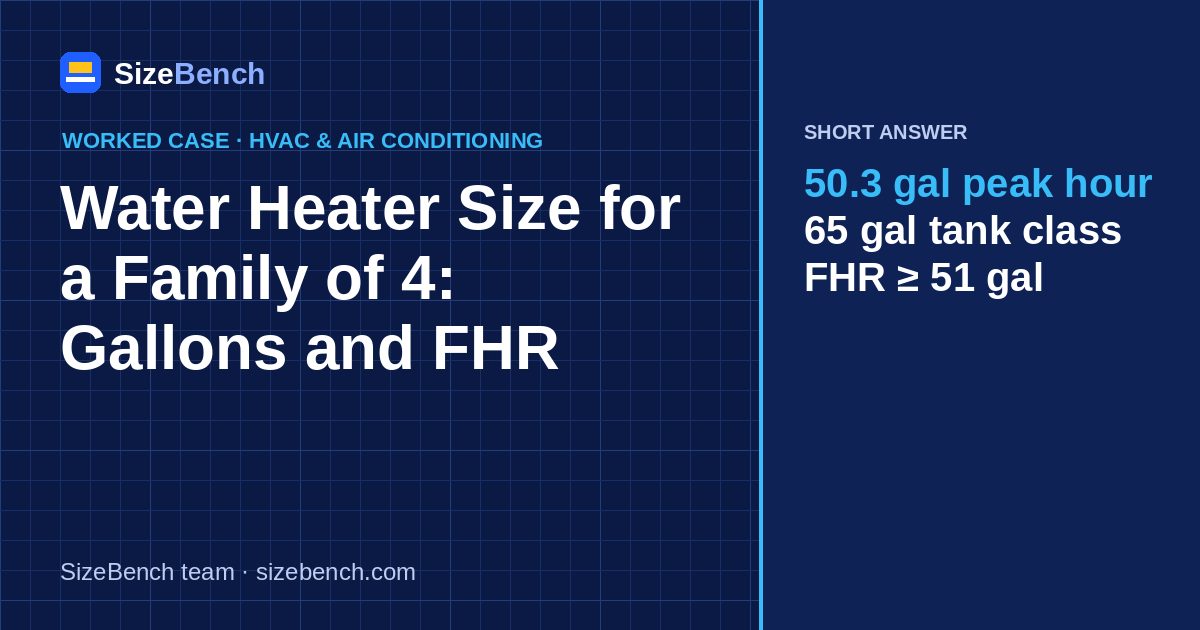
Short answer: each shower uses hot and cold water mixed to about 105 °F. With 50 °F water at the inlet, the hot share is 79%. Four showers then pull 50.3 gallons of hot water in the peak hour. The calculator rounds that to the next standard size, a 65 gallon class. What you really shop for is a heater whose First Hour Rating is at least 51 gallons, plus a margin for the dishwasher. A fast-recovering 50 gallon gas tank or heat pump unit can meet that.

1. Peak-hour demand, not daily use
A tank heater never needs to cover a whole day at once. It reheats as it goes. What matters is the busiest hour, and in most family homes that is the morning shower rush. The Department of Energy's sizing method starts there, and so does the calculator:
Peak-hour demand = showers × flow × minutes × hot-water share
The hot share comes from mixing. Nobody showers at 120 °F. The valve blends tank water with cold to about 105 °F:
Hot share = (105 − 50) ÷ (120 − 50) = 0.786
4 × 2.0 gpm × 8 min × 0.786 = 50.3 gal
2. Tank size versus First Hour Rating
The yellow EnergyGuide label, and the spec sheet, list the First Hour Rating (FHR): how many gallons of hot water the heater can deliver in one hour, starting full. FHR combines the stored water that is usable before the outlet cools with what the burner or element reheats during that hour. Two heaters with the same tank can have very different FHRs:
- Gas tanks recover quickly, so their FHR is often well above the tank size.
- Standard electric tanks recover more slowly, so their FHR is closer to the tank size.
- Heat pump water heaters vary with mode. In heat-pump-only mode recovery is slow, while hybrid mode uses the backup elements to boost it.
So the rule is to match FHR to the peak-hour demand, here 51 gallons or more, and treat the tank size as the second number you look at. The calculator suggests 65 gallons because 50.3 is just over 50. Read that as "a large tank or a strong-recovering 50".
3. Household size
Same 2.0 gpm heads, 8 minute showers and 50 °F inlet, one shower per person in the peak hour:
| People showering in peak hour | Peak-hour demand (gal) | Calculator tank class | Minimum FHR to look for |
|---|---|---|---|
| 2 | 25.1 | 30 gal | 26 gal |
| 3 | 37.7 | 40 gal | 38 gal |
| 4 | 50.3 | 65 gal | 51 gal |
| 5 | 62.9 | 65 gal | 63 gal |
| 6 | 75.4 | 80 gal | 76 gal |
Add the other things that really happen in that hour. A dishwasher started at 7:00, or a load of laundry on warm, pushes the number up. For most families of four, the honest number ends up somewhere between 51 gallons and the high 60s.
4. Inlet water temperature: the hidden variable
Groundwater temperature varies a lot by region and season. Colder inlet water means each shower takes a larger share from the tank, and the tank also reheats more slowly:
| Inlet temperature | Hot share of a 105 °F shower | Peak-hour demand, family of 4 | Calculator tank class |
|---|---|---|---|
| 40 °F (northern winter) | 81% | 52.0 gal | 65 gal |
| 50 °F | 79% | 50.3 gal | 65 gal |
| 55 °F | 77% | 49.2 gal | 50 gal |
| 70 °F (southern summer) | 70% | 44.8 gal | 50 gal |
Size for winter. A heater that is fine in August runs short in February.

5. Showerheads and shower length
The showerhead is the cheapest lever in the whole system:
| Showerhead | Peak-hour demand (4 × 8 min) | Tank class |
|---|---|---|
| 1.5 gpm | 37.7 gal | 40 gal |
| 1.8 gpm | 45.3 gal | 50 gal |
| 2.0 gpm (WaterSense) | 50.3 gal | 65 gal |
| 2.5 gpm (federal maximum) | 62.9 gal | 65 gal |
Going from 2.5 to 2.0 gpm saves 12.6 gallons in the peak hour, about a fifth of the demand. At 1.8 gpm the family drops to the 50 gallon class. That could be enough to keep the 40 gallon tank's slot and buy a 50 with better recovery instead of a taller, heavier 65. Check the closet height and the drain pan size before you assume a 65 fits. Shortening showers from 8 to 6 minutes saves a quarter of the demand.
6. The tankless alternative
A tankless heater has no stored water, so it is sized by flow and temperature rise, not gallons. With two showers running at once:
Flow = 2 × 2.0 gpm = 4.0 gpm
Heat = 500 × 4.0 gpm × 55 °F rise = 110,000 BTU/h (32.2 kW)
| Showers at once | Flow (gpm) | Output (BTU/h) | Output (kW) | Gas input at 95% (BTU/h) | Electric current at 240 V |
|---|---|---|---|---|---|
| 1 | 2.0 | 55,000 | 16.1 | 57,895 | 67 A |
| 2 | 4.0 | 110,000 | 32.2 | 115,789 | 134 A |
| 3 | 6.0 | 165,000 | 48.4 | 173,684 | 201 A |
Gas tankless units handle two showers easily. A whole-house electric tankless unit for two simultaneous showers in a cold climate needs about 134 A, more than many homes can spare. That is why electric tankless works best in warm-inlet regions or for single fixtures.
7. Reading the EnergyGuide label and the spec sheet
- First Hour Rating (gal). The number to compare against your 50.3 gallon peak.
- Uniform Energy Factor (UEF). Efficiency under a standard test. Higher is better, and heat pump models score far above resistance tanks.
- Usage bin. The label states the draw pattern (for example, medium or high) the heater was tested under. A family of four usually belongs in the medium or high bin.
- Tank capacity. Nominal gallons. Usable hot water is somewhat less.
- Recovery rate (gph at a given rise). On spec sheets. Higher recovery means the tank refills faster between showers.
8. Signs the heater is undersized or failing
- Hot water runs out during the last shower, always at the same point. That is undersizing.
- It runs out sooner than it used to. Sediment may fill the tank bottom, or an element or dip tube may have failed.
- Water is lukewarm from the start. Check the thermostat setting and, on electric tanks, the upper element.
- Rumbling or popping noises on gas tanks usually mean sediment. Flush the tank.
9. Replacement checklist
- [ ] Peak-hour demand worked out for winter inlet temperature (50.3 gal here)
- [ ] FHR on the new unit's label at or above that figure
- [ ] Physical fit checked: height, diameter, clearance for service and, for heat pump models, room air volume and condensate drain
- [ ] Venting (gas) or circuit size (electric) matches the new unit
- [ ] Temperature and pressure relief valve piped to a safe discharge point
- [ ] Expansion tank installed if the water supply has a check valve or backflow preventer
- [ ] Thermostat set to 120 °F unless a mixing valve is installed
10. Common mistakes
- Buying by tank gallons alone. Compare FHR.
- Sizing for summer inlet temperature. Winter demand is 7 gallons higher here between 70 °F and 40 °F inlet.
- Turning the thermostat way up to stretch the tank. It works, but it raises scald risk. Install a mixing valve if you do it.
- Ignoring simultaneous use. A tank handles back-to-back showers. A tankless unit must handle all the fixtures running at the same time.
FAQ
Is a 40 gallon water heater enough for 4 people? Only with a strong-recovering unit whose FHR reaches about 51 gallons, or if showers are staggered over more than an hour. At 50.3 gallons of peak demand, a standard 40 gallon electric tank will usually run short.
50 or 65 gallons for a family of four? With 2.0 gpm heads and 55 °F water, demand is 49.2 gallons, so a 50 fits. At 40 °F inlet it rises to 52.0, which points to the 65 gallon class.
What size tankless for a family of 4? For two showers at once with a 55 °F rise: 4.0 gpm and about 110,000 BTU/h of output.
Does a heat pump water heater need a bigger tank? Often one size up, because recovery in efficiency mode is slower. Compare FHR in the mode you will actually use.
What if the kids shower at night? Spreading showers across two peaks halves the hourly demand to about 25 gallons. A 40 or 50 gallon tank then has plenty in reserve.
Case summary
| Item | Result |
|---|---|
| Household | 4 showers in the peak hour, 2.0 gpm, 8 min, 50 °F inlet |
| Hot share of each shower | 79% |
| Peak-hour demand | 50.3 gal |
| Tank class | 65 gal, or any heater with FHR ≥ 51 gal |
| Tankless (2 showers) | 4.0 gpm, 110,000 BTU/h (32.2 kW) |
Different shower habits or a colder inlet? Run the water heater size calculator with your own numbers before you compare FHRs on the spec sheets.
Try it with your own numbersWater Heater Size Calculator (Tank Gallons or Tankless GPM)→Sources and references
- U.S. Department of Energy – Energy Saver: Sizing a new water heater the peak-hour demand method and the First Hour Rating (FHR) used to compare storage water heaters
- ENERGY STAR – Water heaters efficient tank, heat pump and tankless options and the EnergyGuide label
- U.S. EPA WaterSense – Showerheads the 2.0 gpm WaterSense showerhead flow used as the base case
- SizeBench water heater size calculator the mixing fraction, peak-hour demand formula, standard tank sizes and tankless BTU formula used here
Standards and data behind our calculators
How we made this guide
Every number in this guide is calculated by the same code as our calculators, from the standards listed above, and the page is tested before publication. The SizeBench team researched, wrote and reviewed it; we use automation and AI tools to help draft, never to produce the figures. Our methodology →
Revision history
- · Published