The case: a 2,000 sq ft home with a gas furnace, a 1 hp well pump, a sump pump, a 4,500 W electric water heater, an electric range and a 3-ton central air conditioner. The owner wants an automatic standby generator and is choosing between three sizes on the quote.
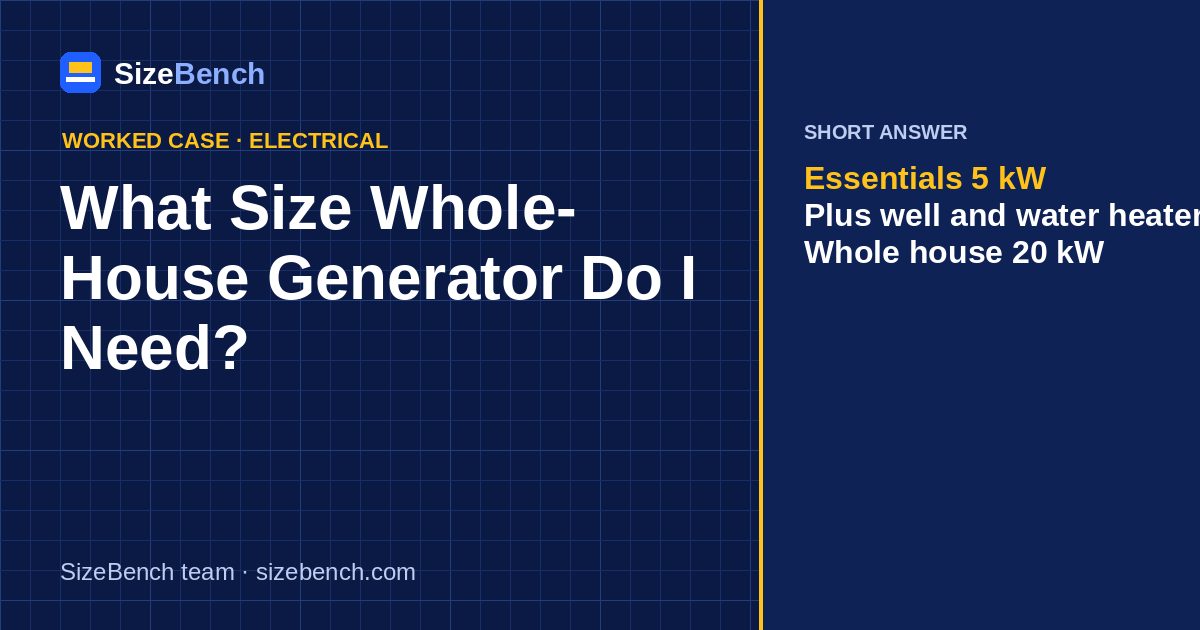
Short answer: essentials alone need about 5.0 kW. Adding the well pump and water heater pushes it to 12 kW. Running the whole house, air conditioning included, needs 20 kW, and only if the dryer is kept off or managed. Every figure uses a 20% margin over the running load.

1. The method: running watts, a margin, then the motor start
Generator sizing has three steps, and the order matters:
- Add the running watts of everything that may be on at the same time.
- Add a margin so the engine is not working flat out for hours. We use 20%, the default in the generator calculator.
- Check the starting demand: everything already running plus the extra surge of the single largest motor while it starts.
Running watts decide the size you buy. Starting watts decide whether the lights dim and the transfer switch drops a load when the air conditioner kicks on.
All wattages below are typical values we assume for this house. Your own numbers come from the nameplates: watts are sometimes printed directly, otherwise multiply nameplate amps by the voltage (120 V or 240 V), as the Department of Energy's appliance guide explains.
2. Tier one: essentials only
| Load | Running watts (assumed) |
|---|---|
| Refrigerator | 200 W |
| Chest freezer | 150 W |
| Furnace blower, 1/2 hp | 700 W |
| Sump pump, 1/2 hp | 1,000 W |
| Lights, TV, internet | 600 W |
| Microwave | 1,200 W |
| Total | 3,850 W |
With the margin: 3,850 × 1.20 = 4,620 W, so the next common size is 5,000 W.
Starting check: the sump pump is the biggest motor in this group. Assuming it needs about 2,000 W extra for a second while starting, the peak is 3,850 + 2,000 = 5,850 W. Any decent 5 kW generator handles that.
3. Tier two: adding the well pump and water heater
Rural homes rarely stop at essentials. Without the well pump there is no water, and without water the household cannot get by for long. We add:
- Well pump, 1 hp at 240 V: 1,500 W running, and we assume about 3,000 W extra while starting.
- Electric water heater: 4,500 W, a pure resistive load with no surge.
Running total: 3,850 + 1,500 + 4,500 = 9,850 W. With the margin, 11,820 W, so 12,000 W.
The water heater is the single largest jump in the whole list. Many installers put it on a load-shed relay that cuts it out whenever a bigger load needs the capacity. That works well, because hot water stays hot in the tank for hours.
4. Tier three: the whole house with central air
Now add the comfort loads:
- 3-ton central air conditioner: about 3,500 W running.
- Electric range, two burners in use: about 3,000 W.
Running total: 16,350 W. With the margin, 19,620 W, so the next size is 20,000 W, which works out to about 83 A at 240 V.
The compressor start is the hard part. A scroll compressor draws a brief inrush several times its running current. The condenser nameplate lists it as LRA (locked-rotor amps). We assume an extra 7,000 W for a direct start. With a soft starter on the condenser we assume half that:
| Air conditioner start | Peak demand (running + start) |
|---|---|
| Direct start, +7,000 W | 23,350 W |
| Soft starter, +3,500 W | 19,850 W |
Standby generators list a motor-starting capability on the spec sheet, often as an LRA figure at a stated voltage dip. Compare it with the condenser's LRA before signing. If the numbers are close, a soft starter is far cheaper in effort than the next generator size up.

5. The fourth tier nobody needs: everything at once
Add a 5,000 W electric dryer and the running load reaches 21,350 W. That calls for 26,000 W, the top of the common residential range. Very few homes actually need it, because nobody runs the dryer, the range, the water heater and the air conditioner at the same moment during an outage.
This is where load management earns its place. A load-shed module or a smart transfer switch drops the water heater, and the dryer if it is on the backed-up panel, when the generator approaches its limit. Take the water heater out of the tier-three list and the running load falls to 11,850 W, which needs 17,500 W with the margin, one size smaller.
6. What the NEC says, in plain words
An automatic standby generator that feeds a home falls under the NEC rules for optional standby systems. Three points matter for sizing:
- Whole-panel automatic transfer: if the transfer switch can move every load in the house automatically, the generator must be able to carry that full load as calculated under the code's load-calculation rules. The other option is load management that keeps the generator from being overloaded.
- Manual transfer or interlock: when the owner chooses what to run, the generator only has to carry the loads the owner selects.
- Transfer equipment is mandatory. The house must be isolated from the utility before the generator powers it, so no current can flow back into the lines and endanger crews.
The exact sections change between code editions and local adoptions, so your electrician and the permit office have the final word.
7. Reading a standby generator's nameplate
- Rated output on propane and on natural gas: they differ. The natural gas rating is usually the lower one, and it is the one that counts if you run on a utility gas line.
- Rated amps at 240 V: compare with your planned transfer switch and the main breaker.
- Motor-starting capability (LRA): compare with the condenser and well pump nameplates.
- Voltage and frequency regulation: a tighter number is gentler on electronics and variable-speed equipment.
8. Installation and inspection checklist
- [ ] Load list built from real nameplates, not from a chart
- [ ] Margin of at least 20% over the running total
- [ ] Largest motor start checked against the generator's LRA capability
- [ ] Transfer switch rated for the service, with load-shed modules if needed
- [ ] Gas supply sized for the generator's full-load consumption, as the manufacturer specifies
- [ ] Clearances from windows, doors and vents as the listing and local code require, because of carbon monoxide
- [ ] Permit and inspection completed, and the utility notified where required
9. Signs the generator is undersized
- Lights dim hard or the transfer switch sheds loads whenever the air conditioner starts: a motor-start problem, not a running-watts problem.
- Generator trips its breaker in the evening: cooking, hot water and air conditioning stacking up together.
- Engine laboring at constant high speed: it is running near 100% for hours, with no margin left.
10. Common mistakes
- Sizing to the main breaker. A 200 A service does not mean a 48 kW generator. Real simultaneous load is a fraction of that.
- Copying a chart that lists the refrigerator at its starting watts. Starting watts are momentary; they belong in the start check, not in the running total.
- Ignoring the natural gas derate. A unit chosen on its propane rating can come up short on a utility gas line.
- Placing a portable generator in the garage. CPSC and Ready.gov both warn about carbon monoxide; generators run outdoors, away from openings.
FAQ
Is a 12 kW generator enough with central air? Not with everything on. The tier-three running load is 16,350 W. Shed the water heater (11,850 W) and add the margin, and you still need 17,500 W.
How many amps is a 20 kW generator? 20,000 W ÷ 240 V = 83.3 A.
Can I skip the margin? You can, and 16,350 W would round to 17,500 W. But an engine generator at full output all night runs hot and uses more fuel per kWh, so a margin is worth one size.
Do I need a soft starter on the AC? With a direct start, the peak in this case reaches 23,350 W. With a soft starter, it is 19,850 W. If the generator's motor-starting rating sits between the two, yes.
What about a portable instead? A 7,500 W portable covers the essentials tier (4,620 W with margin) through an interlock and inlet, but not the well pump plus water heater tier.
Case summary
| Tier | Running load | With 20% margin | Generator |
|---|---|---|---|
| Essentials | 3,850 W | 4,620 W | 5,000 W |
| + well, water heater | 9,850 W | 11,820 W | 12,000 W |
| + central air, range | 16,350 W | 19,620 W | 20,000 W |
| + dryer | 21,350 W | 25,620 W | 26,000 W |
Have your own nameplates in hand? Enter the running watts and the largest motor's surge in the generator size calculator; it uses exactly this method.
Try it with your own numbersGenerator Size Calculator→Sources and references
- NFPA 70, National Electrical Code (NEC) rules for optional standby systems, transfer equipment and load management, described in words
- U.S. Department of Energy – Estimating appliance and home electronic energy use reading wattage from nameplates and converting amps to watts
- Ready.gov – Power outages generator safety and outage preparation
- U.S. Consumer Product Safety Commission carbon monoxide warnings for engine-driven generators
- SizeBench generator size calculator the same running-watts, margin and starting-watts method
Standards and data behind our calculators
How we made this guide
Every number in this guide is calculated by the same code as our calculators, from the standards listed above, and the page is tested before publication. The SizeBench team researched, wrote and reviewed it; we use automation and AI tools to help draft, never to produce the figures. Our methodology →
Revision history
- · Published