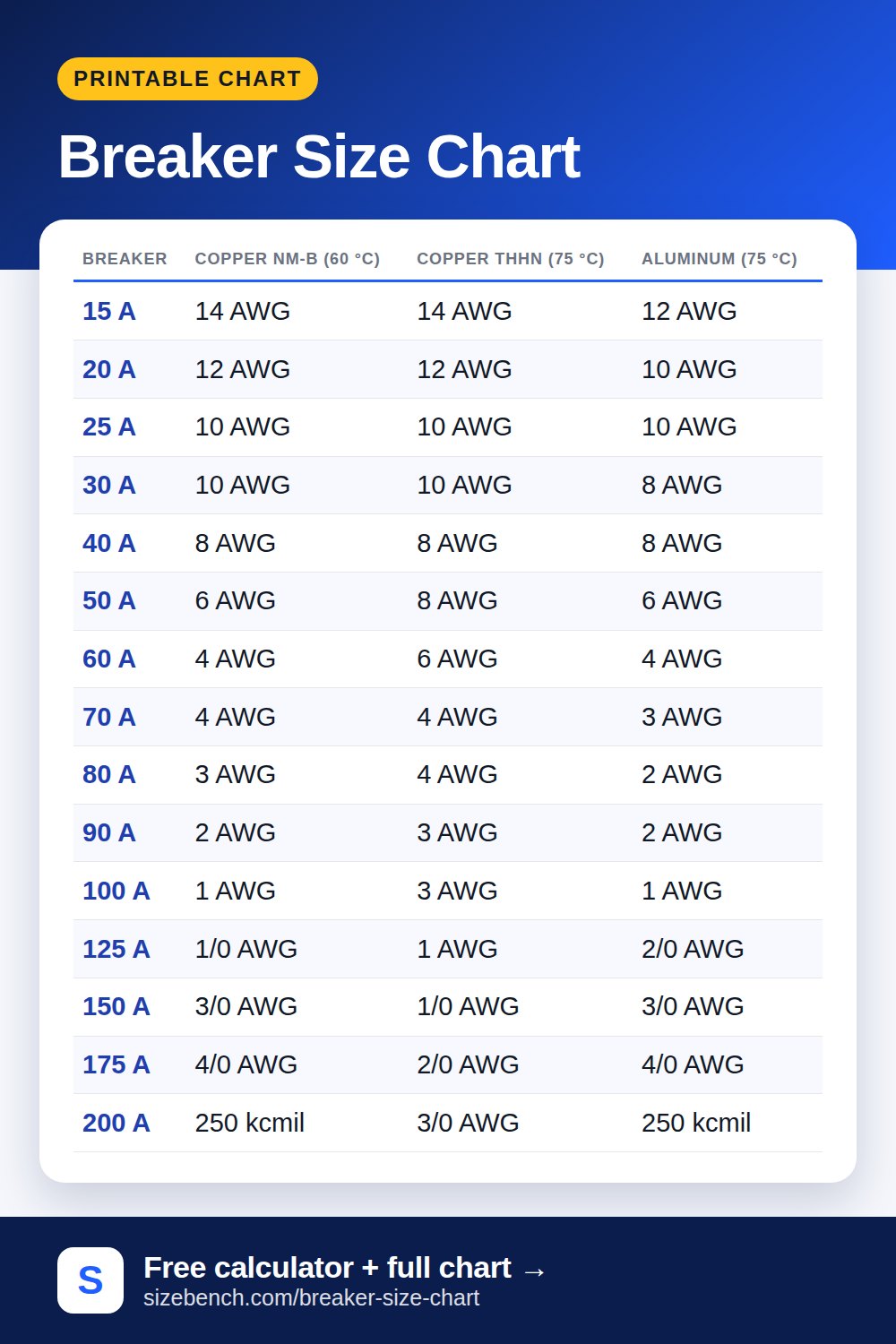
Breaker Size Chart: Wire Gauge and Max Load for Each Breaker
Answer
15 A → 14 AWG · 20 A → 12 AWG · 30 A → 10 AWG
A breaker protects the wire, so the wire's ampacity must be at least the breaker rating. Continuous loads should stay at or below 80% of the breaker (16 A on a 20 A breaker).
Free, no sign-upInstant resultsUpdated October 2026
Breaker, wire and load chart
Breaker
Copper NM-B (60 °C)
Copper THHN (75 °C)
Aluminum (75 °C)
Continuous load (80%)
Max watts 120 V
Max watts 240 V
15 A
14 AWG
14 AWG
12 AWG
12 A
1,800 W
3,600 W
20 A
12 AWG
12 AWG
10 AWG
16 A
2,400 W
4,800 W
25 A
10 AWG
10 AWG
10 AWG
20 A
3,000 W
6,000 W
30 A
10 AWG
10 AWG
8 AWG
24 A
3,600 W
7,200 W
40 A
8 AWG
8 AWG
8 AWG
32 A
–
9,600 W
50 A
6 AWG
8 AWG
6 AWG
40 A
–
12,000 W
60 A
4 AWG
6 AWG
4 AWG
48 A
–
14,400 W
70 A
4 AWG
4 AWG
3 AWG
56 A
–
16,800 W
80 A
3 AWG
4 AWG
2 AWG
64 A
–
19,200 W
90 A
2 AWG
3 AWG
2 AWG
72 A
–
21,600 W
100 A
1 AWG
3 AWG
1 AWG
80 A
–
24,000 W
125 A
1/0 AWG
1 AWG
2/0 AWG
100 A
–
30,000 W
150 A
3/0 AWG
1/0 AWG
3/0 AWG
120 A
–
36,000 W
175 A
4/0 AWG
2/0 AWG
4/0 AWG
140 A
–
42,000 W
200 A
250 kcmil
3/0 AWG
250 kcmil
160 A
–
48,000 W
Max watts = breaker amps × volts. For continuous loads use 80% of those figures. NM-B above 1 AWG is not common; use the THHN column for feeders.
Breaker size
–
How we calculated this
For estimating and educational purposes only. Results are approximate and are not a substitute for a licensed professional, the manufacturer's instructions or your local code. Disclaimer
Pick the breaker from the load current (× 1.25 for continuous loads), then read across for the minimum wire. Never put a larger breaker on an existing wire; replace the wire instead.